
|
A Taste of Traditional Japan in a Beautiful Yamanaka Hot Spring Town 4 nights 5 days The Kayotei |
Day 01
Arrive at Kagaonsen Station /Komatsu Airport |
|
|
At Kagaonsen Station or Komatsu airport, you will be
welcomed by a driver, who will drive you to The Kayotei by private car.
*Please book in advance. *From Kyoto, it is about 1 hour and 45 minutes by limited express train. *From Tokyo, it is about 1 hour by air. *You may also come from Tokyo by shinkansen bullet train; this journey takes about 3 hours. |
 |
|
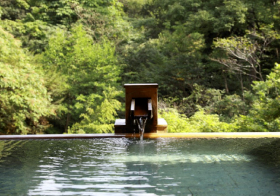
In recent years, the Japanese lifestyle has become increasingly Westernized, and traditional Japan is fading into the background. However, at a ryokan traditional Japanese inn, the unique aesthetic sense of Japan can still be experienced. Staying at a ryokan is the best way to savor the serene beauty of the traditional Japanese lifestyle. |
 |
|
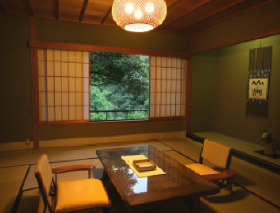
Check in at The Kayotei As you pass through the entrance of The Kayotei, you quickly realize that this is a very special Japanese inn. The ryokan is located in the small hot spring village of Yamanaka in Ishikawa Prefecture, which remains much the same as it has been for many years, seemingly untouched by time. The inn is situated amid majestic trees and lovingly nurtured gardens surrounded by thickly forested hills. Until dinner time why not stroll a cozy Yamanaka Onsen town? |
 |
|
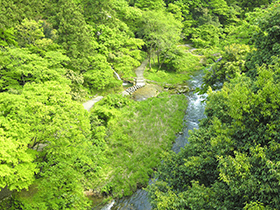
Kakusenkei Nature walk You might try the 2.9km (1.8 mile) Kakusenkei Gorge walking course, or the 4.8km (3.0 mile) jogging course along the rim of the gorge. This route includes the beautiful 1.3km footpath to the Kurotani Bridge. There are several famous historic sites along the walkingroute next to Kakusenkei Gorge. |
 |
|
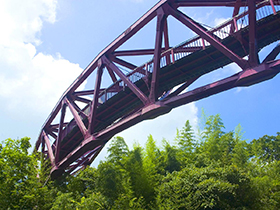
Ayatori Hashi (Cat's Cradle Bridge) The grand master of the Sogetsu school of flower arranging, Hiroshi Teshigahara, designed this unique bridge, with its S-shape and red-purple color. Magen-an This Samurai villa, built at the end of the Meiji era, houses a lovely collection of arts and crafts. |
 |
|
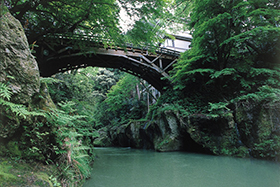
Korogi Bridge (Cricket Bridge) There are various legends regarding the origin of this bridge's name. One of them notes the extremely narrow and steep mountainous roads of Yamanaka and how one misstep could mean disaster. Hence the name "Korogi," which literally means "dangerous road." Basho-do The famous haiku poet Basho visited Yamanaka and enjoyed the scenic beauty of this spot. The Basho-do is a hut similar to the one where he stayed, and there is a small image of Basho inside. |
 |
|
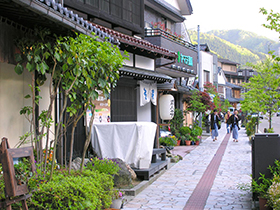
Yuge Kaido street This is the main street running through the town of Yamanaka Onsen. It starts from Kiku No Yu public hot spring bath. You will find lots of shops, galleries featuring local arts and crafts, as well as restaurants on both sides of the street. Return to The Kayotei and relax. You could try a shiatsu traditional Japanese massage treatment. |
|
|

|
Day 02
Yamakanaka Onsen |
||
|
In the morning depart for an exclusive tour with the owner of The Kayotei or one of the staff. Private visit to the studio of a takumi -- a highly skilled traditional craftsman |
||
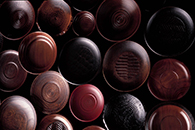
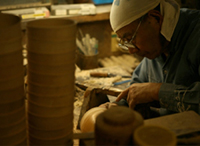 Satake Lacquerware Studio - A private studio tour to visit wood turner Yasuhiro Satake. The third-generation
owner, Satake-san learned his trade from his father, and the family's fine craftsmanship has been cherished and
handed down for 50 years.
Satake Lacquerware Studio - A private studio tour to visit wood turner Yasuhiro Satake. The third-generation
owner, Satake-san learned his trade from his father, and the family's fine craftsmanship has been cherished and
handed down for 50 years.Kutaniyaki Porcelain Studio - Yamanaka has developed into one of the most prominent producers of lacquerware in Japan and is especially known for Kutaniyaki porcelain. In the early Edo era, this new kind of porcelain was created in the village of Kutani, Enuma-gun. You will have a chance to visit the private studio of Shigeo Fujisawa. |
||
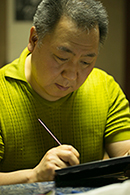 Kaga Maki-e Studio - Maki-e is a painting technique that uses powder and thin layers
of gold, silver and shells combined with lacquer for adorning lacquer boxes, dishes, trays,
furniture and many other items, including modern products such as fountain pens and
watches.
Kaga Maki-e Studio - Maki-e is a painting technique that uses powder and thin layers
of gold, silver and shells combined with lacquer for adorning lacquer boxes, dishes, trays,
furniture and many other items, including modern products such as fountain pens and
watches.* You can try a maki-e making lesson to produce your own souvenir maki-e. *Advance booking is required. *Availability is subject to season. |
||
|
For lunch, you can try some Italian dishes cooked with local specialties. The local restaurant Alla Contadina is run
by owner Koji Sakamoto, who grew up in Yamanaka and had chef training in Venice, Italy. He is now a member
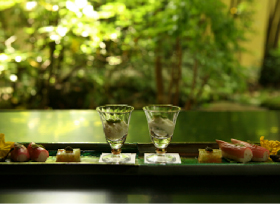
of the Organic Food Producers Group of the Kayotei. Enjoy his unique fusion of Kaga and Italian cuisine. Return to The Kayotei and relax. Savor a fine Kaga-style kaiseki dinner, served on locally crafted dishes. Kanazawa and Kaga are close to the Sea of Japan, so you can enjoy the finest quality seafood. Kaga-style kaiseki ryori Japanese haute cuisine is famous all over Japan. |
||
|
Day 03
Day trip to Shirayama Hime Shrine at Mt. Hakusan and Eiheiji Temple |
||
|
This trip gives you a chance to visit a Japanese holy mountain, accompanied by the owner or ryokan staff. In Japan,
there are three holy mountains -- Mt. Fuji, Mt. Tateyama and Mt. Hakusan. As Mt. Hakusan is the source of
several great rivers, the deity is believed to have divine power over water, which ensures bountiful harvests. Shirayama Hime Shrine is home to the god Izanagi and goddess Izanami, and is dedicated to the holy mountain Hakusan. The temple grounds are serene and beautifully tended, with magnificent 1,000-year-old cedar trees lining the path up to the shrine buildings. |
||
|
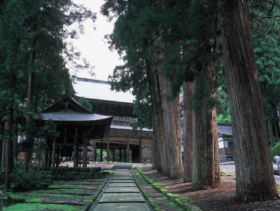
Eiheiji Temple is the head temple of the Soto Sect of Zen Buddhism. This temple
was founded by the famous Buddhist scholar Dogen Zenji, after he finished his Soto
Zen studies in China. It consists of over 70 buildings and structures, all of them
connected by covered walkways. It is still an active monastery, with around 150
practicing Zen monks. Eiheiji is a working temple; there are many monks training
there, but you may have a chance to get a glimpse of their daily life. The town of Eiheiji is a lovely, tranquil place nestled in the mountains along a river - a pleasant place for a stroll or a quiet lunch. Return to The Kayotei. |
 |
|
|
Day 04
Day trip Kanazawa or Gokayama /Shirakawago |
||
|
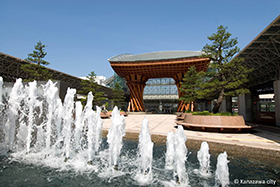
Option 1 Take a day trip to Kanazawa by either express train or private car with optional English speaking guide. During the Edo period (1603-1868), Kanazawa was the seat of the Maeda Clan, the second most powerful feudal clan after the Tokugawa. As a result, Kanazawa became a place of great cultural achievement, to rival Kyoto and Edo (now Tokyo). |
 |
|
|
Today, Kanazawa is still an important city and the capital of Ishikawa Prefecture. The city boasts many historical attractions, such as restored residences and districts, as well as modern museums. But Kanazawa's main attraction is Kenrokuen, one of Japan's "three best landscape gardens," and which many consider the most beautiful of them all. |
||
| The first place to visit is Kenrokuen Garden & Kanazawa Castle Park, originally a private garden next to Kanazawa Castle, and was later developed in the 1620s to 1840s. It is a landscape garden spreading over 100,000 sq.. meters, with Kasumigaike Pond at its center and a variety of hills, streams, smaller ponds and waterfalls to enhance its beauty. Next to Kenrokuen Garden is Kanazawa Castle Park, one of the great symbols of the city's traditional culture, and a legacy of the rich history of arts patronage by the local feudal clan. | 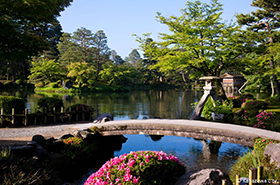 |
|
|
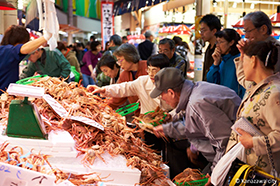
For lunch visit Omicho market. You can find fresh seafood and vegetables here. |
 |
|
| Next stop is the 21st Century Museum of Contemporary Art. This impressive museum, designed by Japanese architects Kazuyo Sejima and Ryue Nishizawa of the SANAA architect office, focuses on works produced since 1980 that "propose new values." The museum's collection includes works by such artists as: Francis Alys, Matthew Barney, Tony Cragg, Olafur Eliasson, James Turrell, Yayoi Kusama and many more. | 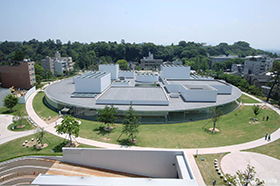 |
|
| In the Higashi Chaya District, you can find traditional geisha houses lining both sides of the street. "Chaya" means teahouse, and geisha -- the famous female entertainers who are icons of Japan, especially Kyoto -- were once a common sight in this area. Some of the wooden houses have been designated as an important preservation district of historic buildings; a few of the teahouses were built as long as 200 years ago and are still in use. |  |
|
|
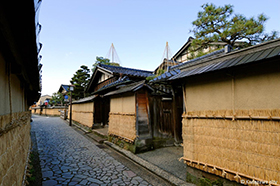
You could also visit the Nagamachi Samurai District. This was a district at the foot of the former Kanazawa Castle, where Samurai and their families lived during the Edo period. The area now preserves the atmosphere of the time, with its remaining Samurai residences, private entrance gates, narrow lanes and canals. One of the main attractions of the district is the centrally located Nomura-ke, a restored residence displaying the lifestyle and artifacts of the time when Samurai prospered. Return to The Kayotei |
 |
|
|
Option 2 Day trip to Shirakawa-Go & Gokayama by private car with an optional English speaking guide |
||
|
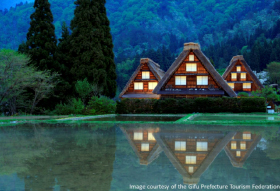
UNESCO World Heritage "SHIRAKAWAGO" The Shirakawa-go and neighboring Gokayama regions line the Shogawa River Valley in the remote mountains that span from Gifu to Toyama Prefectures. Declared a UNESCO world heritage site in 1995, they are famous for their traditional gassho-zukuri farmhouses, some of which are more than 250 years old. Gassho-zukuri means "constructed like hands in prayer", as the farmhouses' steep thatched roofs resemble the hands of Buddhist monks pressed together in prayer. The architectural style developed over many generations and is designed to withstand the large amounts of heavy snow that falls in the region during winter. The roofs, made without nails, provided a large attic space used for cultivating silkworms. Return to The Kayotei |
 |
|
|
Day 05
Departure from Kagaonsen Station / Komatsu Airport |
||
|
Check out from The Kayotei and transfer to Kagaonsen Station or Komatsu airport by private car. To get to Tokyo, there are two options: transfer to Komatsu airport by private car, or go on the shinkansen bullet train, which takes approximately 3 hours. You might also continue to Kyoto by limited express train. It takes about 1 hour and 45 minutes. |
||
|
To view more sample itineraries, click here To view past newsletters, click here For more information on The Ryokan Collection, click here Collaboration offer with Shangri-La Hotel, Tokyo is also available at Hotel Offers |
For more information and queries, please visit www.ryokancollection.com.
