
Discovered during the Muromachi period, Nagato Yumoto Onsen in Yamaguchi Prefecture has flourished for over 600-year history. At the heart of this historic hot spring resort stands Otani Sanso, a grand ryokan renowned throughout the Sanyo and Sanin regions. Adjacent to it lies the exclusive annex, “Bettei Otozure.”
A Modern-Chic hot spring ryokan by a serene river
The ryokan takes its name from the Otozure River, which flows through the heart of the hot spring town. This crystal-clear river offers the perfect opportunity to admire cherry blossoms in the spring and fireflies in the summer.
From the moment guests pass through the entrance, they are drawn to a tranquil water basin. As one proceeds along the corridor, a hall with a striking conical timber ceiling gradually reveals itself.
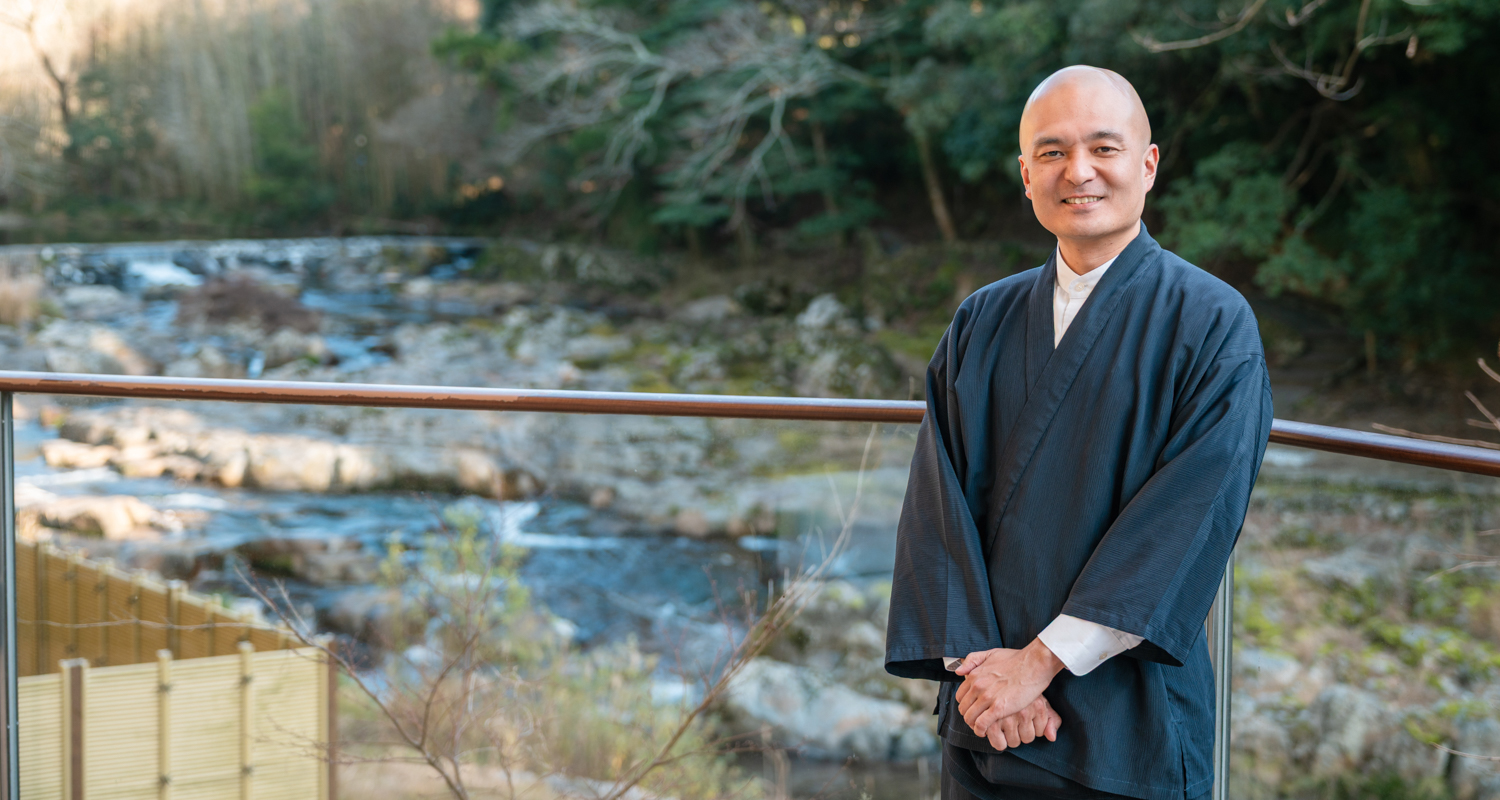
“At first glance, it may evoke the roofline of a Balinese resort, yet it is in fact inspired by the Kasatei teahouse at Kodaiji Temple,” says Mr. Kazuhiro Otani, president and fifth-generation proprietor of Otani Sanso.
The hall is designed without windows, allowing it to open seamlessly to the surrounding air. The garden beyond—its trees and moss-covered stone walls—offers a quietly refined beauty. Completed in 2006, the villa’s modern, refined sukiya-style design belies its age. A closer look reveals carefully crafted details, including natural stone walls and floorboards finished with traditional naguri texture—elements that invite quiet admiration, reflecting a design in which no expense has been spared.
Just 18 rooms, thoughtfully appointed
“We requested the architects to create a design that allows guests to move throughout the building barefoot,” says Mr. Otani.
Guests remove their shoes in the foyer and immediately feel the gentle texture of tatami beneath their feet. Beyond the reception, a spacious and thoughtfully designed area unfolds. In the library, guests will find a curated selection of books, including works by the local painter Yasuo Kazuki and the children’s poet Misuzu Kaneko—both regarded as sources of local pride—as well as a refined collection of art volumes. As admission is limited to guests aged 13 and above, a sense of tranquility is preserved throughout the property.
The pottery on display in the gallery is exquisite.
“Near Nagato Yumoto lies an area called Fukawa, home to five historic pottery kilns,” Mr. Otani explains. “The artists from the families who create Fukawa Hagi ware have been closely associated with us since our founding. These include Itakura Shinbei Kiln, Tahara Tōbei Kiln, Shinjō Sukemon Kiln, Sakakura Zen’emon Kiln, and Sakata Deika Kiln. We also have long-standing relationships with Miwa Kyūsetsu Kiln in Hagi, Tenchōzan Kiln, and the ceramic artist Tsukasa Kaneko, as well as the glass artist Shin Nishikawa.” Their works are displayed throughout the property, and at the Japanese restaurant Un’yū, dinner is served on tableware crafted by these artists.
Events featuring these artists are also highly popular.
Other facilities include a tea room, a spacious communal bath, the spa “Grande Spa OTOZURE”, and a fitness gym. At “The Bar OTOZURE”, sparkling wine and other beverages are offered on a complimentary basis during the early evening.
The guest rooms are set across expansive grounds, with just 18 in total. Each features a private open-air bath with water flowing directly from the natural hot spring source.
All in all, the property offers an exceptionally refined and thoughtfully curated ryokan experience.
Visitor numbers fell to less than half their peak
Every year in late March, just before the cherry blossoms begin to bloom, the traditional Kawadoko Opening is held along the Otozure River.
With the extensive facilities offered at Otani Sanso and Bettei Otozure, guests could easily spend their entire stay within the comfort of the property itself. Yet Nagato Yumoto Onsen is a hot spring town rich in charm, naturally inviting visitors to stroll through its streets and explore.
Today, the town bustles with younger travelers, yet this renewed vitality has been hard-won.
Mr. Otani explains:
“I returned to my hometown around 2005, just as construction on Bettei Otozure was beginning. The building was completed and opened the following year. The real challenge, however, lay in the gradual signs of decline that had begun to affect the hot spring town itself.”
The peak year for Nagato-Yumoto Onsen was 1984, when approximately 390,000 guests stayed annually. Thereafter, visitor numbers steadily declined, and by 2014, the number of overnight guests had fallen to around 180,000—less than half of its peak.
“When I was a child, the town was filled with group tour buses,” He recalls. “But with the arrival of the internet age, travel shifted from group tours to more individual, independent styles. It was against this backdrop that a shocking event occurred: a long-established ryokan, with a history spanning 150 years, closed its doors.”
In 2014, a historic hotel that had operated since the Edo period declared bankruptcy, leaving behind a large vacant structure at the heart of the town.
The Nagato Yumoto Mirai Project begins
“This was when local residents truly began to share a sense of crisis. At the same time, the shops in the hot spring town gradually disappeared one by one, until eventually none remained,” he recalls.
By 2014, revitalizing and regenerating the town had become an urgent priority for the community.
“It was the city of Nagato that created the initial momentum for revitalization. As tourism became increasingly important, the presence of an abandoned building at the center of the hot spring town risked diminishing the image of the entire city and draining its vitality. Recognizing this, the city took the initiative to have it demolished using public funds.”
Mayor Kurawo Onishi sought to attract Hoshino Resorts to develop the site.
“When Hoshino Resorts’ Representative Yoshiharu Hoshino heard the proposal, his response was quite unexpected,” Mr. Otani says. “He said, ‘If a single Hoshino Resorts hotel were built here, it would not change the situation very much. Instead, why not create a master plan for the entire hot spring district?’. Nagato Yumoto subsequently became the first in a series of town development projects the company would later undertake across Japan.”
In April 2016, a business implementation agreement was signed with Hoshino Resorts KAI, and by August of the same year the master plan had been completed. With that, the Nagato Yumoto Mirai Project officially began.
A rare success story of public–private partnership
The Otozure River, which flows through the heart of the hot spring district, falls under the jurisdiction of the prefectural government. As a result, the project required close cooperation among Yamaguchi Prefecture, the City of Nagato, and the private sector.
“It was also fortunate that Mr. Hayato Kimura, who had been seconded from the Ministry of Economy, Trade and Industry to the City of Nagato, was involved on the administrative side. He is an exceptional leader,” Mr. Otani says.
In the end, the project became one of the rare examples in Japan of a successful public–private partnership. The government strongly encouraged the participation of local stakeholders. While the administrative side could take the lead in improving the physical infrastructure, refining the “soft” aspects—such as services, guest experiences, and the overall atmosphere—had to come from the local community itself. Without genuine commitment from the private sector, the project would never have succeeded. A robust framework for the project was established through close collaboration between the public and private sectors.
“There are 12 ryokans in the town, including Hoshino Resorts’ property. Each has its own distinct vision, so bringing them into alignment required time and care. Our aim was to elevate the value of the entire area and, in doing so, attract discerning visitors. Simply put, we set out to position the town among Japan’s top ten hot spring destinations,” says Mr. Otani.
“But this does not mean returning to how the town looked 40 years ago. Rather, it is about those who live here today cultivating a living culture deeply rooted in and engaged with the region. After all, having hot springs and a river woven into daily life is something quite extraordinary. One might end the day with a quiet soak in the Onsen or spend time by the river in easy conversation. Residents, staff, newcomers, and visitors alike share this space, each finding their own way to enjoy it. In turn, this fosters gentle economic activity, creates a natural sense of circulation, and forms the foundation of a sustainable way of life.”
A remarkable spring source, hidden within Onto
In the master plan, the appeal of Nagato-Yumoto Onsen was distilled into six key elements: public bathhouse, culinary strolling, cultural experiences, circulation pathway, picturesque spots, and spaces for rest and quiet contemplation.
Along the river, soto-yu (public bathhouses) and kawadoko (riverside platforms) were thoughtfully introduced, while steppingstones were placed at four points, allowing visitors to cross the water at a gentle pace. Both the kawadoko and the steppingstones underwent extensive testing, requiring more than three years before their final installation.
Of these six elements, the one that resonated most deeply with Mr. Otani was the public bathing experience—most notably Onto, the historic public bathhouse. He personally oversaw its reconstruction, ensuring that the site’s enduring character and the vitality of its abundant spring source were carefully preserved.
“40 years ago, I used to bathe here myself,” he recalls. “In the evenings, children would gather at this bathhouse. But when I returned to my hometown 20 years ago, that scene had vanished. The building had fallen into disrepair—aging, poorly maintained, and no longer a place that appealed to younger generations or visitors. I felt strongly that this bathhouse should be revived as a symbol of the town’s renewal. Yet rather than simply restoring its appearance, I wanted to create a public bathhouse of genuine interest—one deeply rooted in the unique history of this place. If each business owner were to develop their own hot spring facility or restaurant independently, the result would lack cohesion. It was essential to conceive the river, the hot spring, the plaza, and the surrounding restaurants as part of a single, unified spatial design.”
However, during the reconstruction of the public bathhouse, the dismantling of the aging structure revealed an unexpected and remarkable discovery.
“When the stone slabs covering the bedrock were removed, we realized that the hot spring was gushing directly from the rock itself. I remember thinking, ‘This is a naturally emerging spring!’ It was truly remarkable.” He spoke.
“The appearance of the source had remained unchanged for some 600 years. Over the centuries, countless people have brought their joys and sorrows here, and the spring has returned them to their natural state—quite literally, stripped bare. It made me realize once again just how extraordinary this place is.”
Yet another surprise awaited.
“In fact, a second spring source emerged from beneath the bath itself—a so-called ‘foot-source’ spring, where the water wells up directly beneath where one bathes. In general, hot spring water is at its purest while still underground. Once it reaches the surface, it comes into contact with air and begins to oxidize. This is why the quality of a hot spring often depends on the distance between the source and the bath. What makes a foot-source spring exceptional is that this distance is effectively zero. The water flows into the bath without oxidation, preserving an extraordinary level of purity. Even within Japan, it is a rare and precious natural phenomenon. This realization led to the concept of allowing guests to experience the spring exactly as it emerges”.
Freshly emerging onsen, flowing in abundance
The hot spring flows at approximately 131 liters per minute, maintaining a gentle temperature of around 39°C—what might be described as a comfortably lukewarm bath. With this in mind, Mr. Otani made a specific request to the architect.
“Do not cover the bedrock—leave it exposed. Do not dilute the water, not even with cold water. Do not adjust the temperature. Let the spring flow freely, overflowing in its natural state.”
The designer immediately embraced the concept.
“He said, ‘This is akin to misogi—a ritual purification. Let us design the very act of entering the bath as a sacred experience.’”
The concept echoes the structure of a Shinto shrine: just as visitors cleanse their hands and rinse their mouths before approaching the main hall, guests here first purify themselves at the washing area before immersing themselves in the bath.
This philosophy is deeply rooted in the site’s history. The spring rights belong to Taineiji Temple, a Soto Zen temple, and according to a legend dating back some 600 years, the spring itself is a divine gift—bestowed by a deity and protected ever since.
Mr. Otani told us the story:
One day, on the grounds of Taineiji Temple, Zen Master Jōan, the third abbot, noticed an old man seated upon a stone and asked his name. The man replied that he was the Great Deity of Sumiyoshi Shrine, the principal shrine of Nagato Province. The abbot invited him into the temple and guided him along the Buddhist path. Later, having received a brocade priest’s robe, the old man said in gratitude, “I have caused a hot spring to emerge here—please make use of it.” With those words, he transformed into a dragon and ascended to the heavens.
“It is for this reason that the bathhouse was designed upon the bedrock, embodying a synthesis of Shinto and Buddhist thought. To ensure guests could fully appreciate this “newborn” spring, the dimensions of the baths were carefully calibrated according to the flow rate. When divided into separate baths for men and women, we found that eight square meters per bath was ideal. Though modest in size, the highest-quality water flows continuously and with vigor.” Mr. Otani said.
The water itself is a simple alkaline spring, entering the baths at approximately 36~38°C. Its gentle warmth encourages prolonged bathing; soaking for around 20 minutes allows the minerals to permeate the skin and warm the body from within. It is, without exaggeration, a treasure at the heart of Nagato Yumoto Onsen.
In 2023, Onto was awarded the Yudō Culture Award—the highest honor bestowed by the Yudō Culture Promotion Association—at a ceremony held at Daitokuji Temple in Kyoto. Mr. Otani attended alongside Mr. Keisei Iwata, head priest of Taineiji Temple, and Mr. Michio Naruse, chief priest of Sumiyoshi Shrine.
Prior to its reconstruction, Onto and its surrounding bathing facilities operated at an annual deficit of approximately 60 million yen. By fiscal year 2025, the fifth year after reopening—the operation had successfully turned profitable.
From zero shops to 17
Another highlight for visitors is the Uta Akari illumination, held through early March and inspired by the poetry of Misuzu Kaneko. In the Gento Rondo installation, shifting lights move in quiet harmony with poetry readings and music, while shadows play softly across bamboo-lined steps and open plazas. In Misuzu’s Garden, thousands of lantern-like vessels, created by local students, suffuse the space with a gentle, enchanting glow.
A decade after the revitalization plan was set in motion, the town was completely reborn.
“Today, we are actively repurposing vacant buildings throughout the hot spring district. In an area once known for Hagi pottery, we have opened a café. A former pharmacy has become a craft beer bar. There are yakitori shops, a soba restaurant, and even a hotel with an Italian restaurant serving exceptional pizza. The number of establishments has grown from zero to seventeen. But beyond the physical developments, it is the softer elements—events, culture, and experiences—that require the sustained commitment of the private sector.”
Over these ten years, perhaps the most valuable achievement has been the relationships built along the way.
“In a larger hot spring town, such sweeping changes would be difficult to achieve. In Nagato-Yumoto Onsen, however, everything lies within a ten-minute walk, and that compact scale has worked in our favor. Even now, we remain in close communication—often on a near-daily basis. That, in itself, is one of our greatest assets.”
Immersion in healing waters and san-do cuisine
Let’s get back to Bettei Otozure.
Each guest room features a private open-air bath with water drawn directly from the source. The alkaline spring leaves the skin exceptionally soft, and the ability to bathe at any time, in complete privacy, is a rare luxury. Guests may also enjoy the expansive baths at the adjacent Otani Sanso, offering a rich variety of bathing experiences.
As for the cuisine, dinner takes the form of kaiseki, guided by the philosophy of san-do local ingredients, prepared using local methods, and enjoyed in their place of origin. Each course reflects this ethos with refined precision.
Along the Sea of Japan, the region is blessed with an abundance of superb seafood. Unusually for a ryokan, Bettei Otozure holds a wholesaler’s license, allowing it to procure fish and produce directly from the market and ensure exceptional quality.
For breakfast, those who choose a Western-style option will find the freshly baked, house-made bread exceptionally delicious.
At both dinner and breakfast, each carefully crafted dish offers flavors that seem to gently permeate the body.
A single night is scarcely enough to take in all that the ryokan and its surrounding town have to offer. Guests leave with a quiet promise to themselves—that next time, they will return for a longer stay.
Kazuhiro Otani: President and fifth-generation proprietor of Otani Sanso
Born in Yamaguchi Prefecture in 1979, he gained hands-on experience at a ryokan in a renowned hot spring resort before joining the family business, Otani Sanso, in 2005. He was appointed President and CEO in 2020. In 2019, he was named Chairman of the Yamaguchi Prefecture Hot Spring Association, and following his resignation in 2022, he currently serves as Vice Chairman. In 2018, he founded Nagato Yumori Co., Ltd. to lead the redevelopment of the aging Onto hot spring and serve as its co-representative. In 2023, he was appointed Chairman of the Nagato Yumoto Hot Spring Inn Association.
OTANISANSO
Address: 2208 Fukawa Yumoto, Nagato, Yamaguchi 759-4103Phone: +81 0837-25-3300
Check‑in: 15:00 / Check‑out: 11:00
Otozure
Address: 2208 Fukawa-yumoto, Nagato-shi, Yamaguchi 759-4103Phone: +81 0837-25-3377
Check‑in: 14:00 / Check‑out: 11:00