As one passes through the entrance of Kayotei for the first time it is evident that this is a very special Japanese inn. This luxury ryokan is located in the small hot springs village of Yamanaka in Ishikawa prefecture. The village remains much the same as it has for many years, seemingly untouched by time. The inn is surrounded by majestic trees and lovingly nurtured gardens encircled by thickly forested hills.
Kayotei's ten suite rooms are arranged in the traditional sukiya style of a tea ceremony pavilion. Guests wear no slippers in this ryokan; the walkways are tatami, as one would in the home of a relative or close friend. These are the rare and subtle differences that make time spent in Kayotei such a warm and welcoming experience.
A stroll through Kayotei is one of discovery, for original painted screens, fine works of pottery, and antique tansu adorn the hallways and spaces of this inn.
ROOMS
ROOMHigashiyama Family Suite
This room is a combination of Higashiyama suite and Japanese Junior suite with balcony & privat…
ROOMBasho Family Suite
This room is a combination of Japanese-Western style room and Japanese Junior suite with balcon…
ROOMKokutani Suite
This room used to be one of the Japanese Junior Suite rooms, which was renovated in October 202…
ROOMHigashiyama Suite
The higashiyama room has an expansive view of Kayotei`s own forested mountains surrounding the …
ROOMJapanese Junior Suite with Balcony & Private Open-Air Bath
Japanese Junior Suite with Balcony & Private Open-Air Bath (Shower at the balcony only)
ROOMJapanese Suite with Shower
This room has a large window to let in the beauty of the forested hills outside. Relax on the b…
ROOMJapanese-Western Style Room (No Private Bath or Shower)
Coming Soon
ROOMHigashiyama Family Suite 2-6 sqmPrivate Open-air BathFuton
This room is a combination of Higashiyama suite and Japanese Junior suite with balcony & private open air bath.
Ask *Room rates at the Ryokan vary depending on the season and booking status. Therefore, we provide an estimated amount as a reference.REQUEST THIS ROOM
ROOMBasho Family Suite 2-5 sqmPrivate Open-air BathBed
This room is a combination of Japanese-Western style room and Japanese Junior suite with balcony & private open air bath.
Ask *Room rates at the Ryokan vary depending on the season and booking status. Therefore, we provide an estimated amount as a reference.REQUEST THIS ROOM
ROOMKokutani Suite 2-4 sqmPrivate Open-air BathBed
This room used to be one of the Japanese Junior Suite rooms, which was renovated in October 2020 and has now newly reborn as a cozy suite room with a private open-air bath. The room is suitable for a family, as well as couples and friends, accommodating up to 4 people. Relax on the balcony chairs and enjoy the view of the gorge beyond. Whether the expanse before you is the deep green of new spring growth, the vibrant red and orange of autumn, or the purity of newly fallen snow, this will be a visual experience to remember.
Ask *Room rates at the Ryokan vary depending on the season and booking status. Therefore, we provide an estimated amount as a reference.REQUEST THIS ROOM
ROOMHigashiyama Suite 1-4 sqmIndoor BathFuton
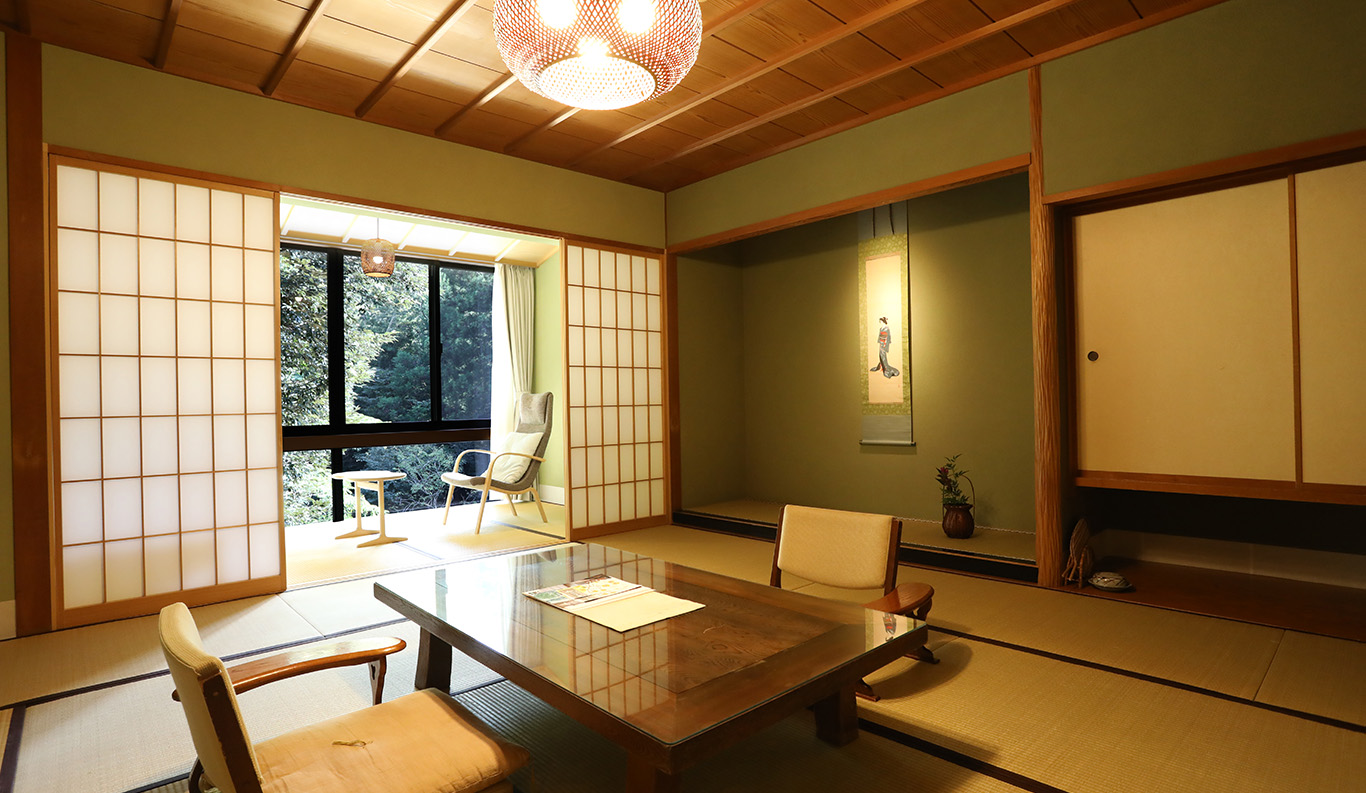
The higashiyama room has an expansive view of Kayotei`s own forested mountains surrounding the property. This is a tatami room in pure Japanese style, with a low table of solid wood from an ancient tree. A veranda provides a tranquil space to gaze upon the forest, listen to the breeze passing through the trees, and savor the gentle sound of the flowing river below.
Ask *Room rates at the Ryokan vary depending on the season and booking status. Therefore, we provide an estimated amount as a reference.REQUEST THIS ROOM
ROOMJapanese Junior Suite with Balcony & Private Open-Air Bath 2-3 sqmPrivate Open-air BathFuton
Japanese Junior Suite with Balcony & Private Open-Air Bath (Shower at the balcony only)
Ask *Room rates at the Ryokan vary depending on the season and booking status. Therefore, we provide an estimated amount as a reference.REQUEST THIS ROOM
ROOMJapanese Suite with Shower 2-4 sqmShowerFuton
This room has a large window to let in the beauty of the forested hills outside. Relax on the balcony chairs and enjoy the view of the pristine mountains beyond. Whether the expanse before you is the deep green of new spring growth, the vibrant red and orange of autumn, or the purity of newly fallen snow, this will be a visual experience to remember.
Ask *Room rates at the Ryokan vary depending on the season and booking status. Therefore, we provide an estimated amount as a reference.REQUEST THIS ROOM
ROOMJapanese-Western Style Room (No Private Bath or Shower) 2-3 sqmNo BathBed
Coming Soon
Ask *Room rates at the Ryokan vary depending on the season and booking status. Therefore, we provide an estimated amount as a reference.REQUEST THIS ROOM
FACILITIES & SERVICES
Bath
It is said the influential Buddhist priest Gyoki first discovered the hot springs of Yamanaka i…
Kokin Salon - Bar
Upon arrival at Kayotei make your first stop the kokin salon bar for a relaxing cup of complime…
Lobby
The expansive entrance and lobby of Kayotei welcome guests as if returning home after a long jo…
Ryotei (Meal)
Kayotei's skilled chefs are masters of the art of true Japanese kaiseki cuisine. Guests dine i…
Bath
It is said the influential Buddhist priest Gyoki first discovered the hot springs of Yamanaka in the Nara period of the 8th century, and ever since these onsen springs have been renowned for their soothing and curative properties. The baths at Kayotei are pure luxury, as befitting such special waters. Kayotei`s main bath is surrounded by towering glass walls which seem to draw the pristine forested hills inside. The baths at Kayotei are always open, and with only ten guest rooms at this ryokan this experience may well be all your own.
Kokin Salon - Bar
Upon arrival at Kayotei make your first stop the kokin salon bar for a relaxing cup of complimentary herb tea, locally grown in the mountains and valleys surrounding the Yamanaka onsen region. A cup of soothing tea while soaking in the view from the kokin salon balcony is just the beginning of the Kayotei experience.
Lobby
The expansive entrance and lobby of Kayotei welcome guests as if returning home after a long journey. The hardwood floor of the hallways and public spaces are covered with a special tatami that makes walking through the beautifully adorned premises truly pleasant and comfortable. Large windows let in light and the beauty of the garden that seems to be as one with the ryokan interior. The architectural and interior design, traditional art and modern sculpture displayed here mean that every glance is bound to be met by artistic and aesthetic beauty.
Ryotei (Meal)
Kayotei's skilled chefs are masters of the art of true Japanese kaiseki cuisine. Guests dine in the privacy of tatami rooms in the style of Japan's exclusive ryotei restaurants. The meals here are exquisitely prepared with attention to every detail and are a work of visual as well as culinary art. Kayotei's cuisine is as wonderfully diverse as the seasons in this part of Japan, as chefs prepare meals using local seafood and locally grown seasonal vegetables.
Experience
A Taste of Traditional Japan in a Beautiful Yamanaka Hot Spring Town Kaga, ISHIKAWA 4 Days 5 NightsMore
Highlights of Japan - Yamanaka Onsen Tokyo - Kyoto - Kanazawa - Yamashiro Onsen - Takayama - Tokyo 11 Days 10 NightsMore
Experience
A Taste of Traditional Japan in a Beautiful Yamanaka Hot Spring Town Kaga, ISHIKAWA 4 Days 5 Nights
Day 1
Arrive at Kagaonsen Station / Komatsu Airport
At Kagaonsen Station or Komatsu airport, you will be welcomed by a driver, who will drive you to The Kayotei by private car.
*Please book in advance.
*From Kyoto, it is about 1 hour and 45 minutes by limited express train.
*From Tokyo, it is about 1 hour by air.
*You may also come from Tokyo by shinkansen bullet train; this journey takes about 3 hours.
In recent years, the Japanese lifestyle has become increasingly Westernized, and traditional Japan is fading into the background. However, at a ryokan traditional Japanese inn, the unique aesthetic sense of Japan can still be experienced. Staying at a ryokan is the best way to savor the serene beauty of the traditional Japanese lifestyle.
Check in at The Kayotei
As you pass through the entrance of The Kayotei, you quickly realize that this is a very special Japanese inn. The ryokan is located in the small hot spring village of Yamanaka in Ishikawa Prefecture, which remains much the same as it has been for many years, seemingly untouched by time. The inn is situated amid majestic trees and lovingly nurtured gardens surrounded by thickly forested hills.
~The Artisans & Organic Food Producers Group of The Kayotei~
More than 20 local artisans and craftsmen affiliated with The Kayotei belong to this Ishikawa region group. The members of the group are dedicated to protecting and preserving the ancient culture of Ishikawa and maintaining the traditional production techniques.
They produce any number of products, including natural, chemical-free foods and sake, wooden bowls, washi (Japanese paper), and traditional wooden furnishings, all of which are fundamental to Japanese-style interior design.
All the members are devoted to creating work with compassion and consideration for the user’s health. While honoring and respecting tradition, they make products that are gentle to the body. In many cases, their craftsmanship has extended for several generations. The wealth of culture that Ishikawa has conveyed should be further recognized around the world.
As a traditional luxury ryokan, The Kayotei staff see themselves as the inheritors and keepers of the region’s traditions — as a “vessel to showcase the region that surrounds us.”
The Kayotei offers its guests the opportunity to participate in producing captivating and charming creations firsthand. As you discover new environments, they provide you with the high level of personalized service that one come to expect at Yamanaka Onsen.
Visits to studios and craftmen’s workshops can be arranged upon request.
*Advance booking is required.
Artisans
・Wood turner’s studio and private gallery
・Kutani porcelain master’s studio and private gallery
・Japanese Tea Ceremony at a master’s private home
・Wooden furniture artist’s studio
・Washi, Japanese paper making studio
・Maki-e lacquerware studio
・Tatami mat maker’s workshop
Food producers
・Matsuura Sake brewery
・Yamanaka Shoyu (soy sauce) brewery
・Wagashi (Japanese sweets) maker
・Aigamo (duck) method organic rice farm
(Aigamo (duck) method organic rice farm is only available during the rice planting season between May and June.)
・Soba maker
Day 2
Yamanaka Onsen
In the morning depart for an exclusive tour with the Kayotei management team.
=Private visit to the studio of a takumi — a highly skilled traditional craftsman=
Satake Lacquerware Studio – A private studio tour to visit wood turner Yasuhiro Satake. The third-generation owner, Satake-san learned his trade from his father, and the family’s fine craftsmanship has been cherished and handed down for 50 years.
Kutaniyaki Porcelain Studio – Yamanaka has developed into one of the most prominent producers of lacquerware in Japan and is especially known for Kutaniyaki porcelain. In the early Edo era, this new kind of porcelain was created in the village of Kutani, Enuma-gun. You will have a chance to visit the private studio of Shigeo Fujisawa.
Kaga Maki-e Studio – Maki-e is a painting technique that uses powder and thin layers of gold, silver and shells combined with lacquer for adorning lacquer boxes, dishes, trays, furniture and many other items, including modern products such as fountain pens and watches.
* You can try a maki-e making lesson to produce your own souvenir maki-e.
*Advance booking is required.
*Availability is subject to season.
For lunch, you can try some Italian dishes cooked with local specialties. The local restaurant Alla Contadina is run by owner Koji Sakamoto, who grew up in Yamanaka and had chef training in Venice, Italy. He is now a member of the Organic Food Producers Group of the Kayotei. Enjoy his unique fusion of Kaga and Italian cuisine.
Return to The Kayotei and relax.
Savor a fine Kaga-style kaiseki dinner, served on locally crafted dishes.
Kanazawa and Kaga are close to the Sea of Japan, so you can enjoy the finest quality seafood. Kaga-style kaiseki ryori Japanese haute cuisine is famous all over Japan.
Day 3
Day trip to Eiheiji Temple
Eiheiji Temple is the head temple of the Soto Sect of Zen Buddhism. This temple was founded by the famous Buddhist scholar Dogen Zenji, after he finished his Soto Zen studies in China. It consists of over 70 buildings and structures, all of them connected by covered walkways. It is still an active monastery, with around 150 practicing Zen monks. Eiheiji is a working temple; there are many monks training there, but you may have a chance to get a glimpse of their daily life.
The town of Eiheiji is a lovely, tranquil place nestled in the mountains along a river – a pleasant place for a stroll or a quiet lunch.
=Explore Yamanaka Onsen town=
Kakusenkei Nature walk
You might try the 2.9km (1.8 mile) Kakusenkei Gorge walking course, or the 4.8km (3.0 mile) jogging course along the rim of the gorge. This route includes the beautiful 1.3km footpath to the Kurotani Bridge.
There are several famous historic sites along the walking route next to Kakusenkei Gorge.
Basho-do
The famous haiku poet Basho visited Yamanaka and enjoyed the scenic beauty of this spot. The Basho-do is a hut similar to the one where he stayed, and there is a small image of Basho inside.
Ayatori Hashi (Cat’s Cradle Bridge)
The grand master of the Sogetsu school of flower arranging, Hiroshi Teshigahara, designed this unique bridge, with its S-shape and red-purple color.
Magen-an
This Samurai villa, built at the end of the Meiji era, houses a lovely collection of arts and crafts.
Korogi Bridge (Cricket Bridge)
There are various legends regarding the origin of this bridge’s name. One of them notes the extremely narrow and steep mountainous roads of Yamanaka and how one misstep could mean disaster. Hence the name “Korogi,” which literally means “dangerous road.”
Yuge Kaido street
This is the main street running through the town of Yamanaka Onsen. It starts from Kiku No You public hot spring bath. You will find lots of shops, galleries featuring local arts and crafts, as well as restaurants on both sides of the street.
Return to The Kayotei and relax. You could try a shiatsu traditional Japanese massage treatment.
Return to The Kayotei.
Day 4
Day trip to Kanazawa
Take a day trip to Kanazawa by private car with English-speaking guide.
During the Edo Period, Kanazawa was the seat of the Maeda Clan, the second most powerful feudal clan after the Tokugawa. As a result, Kanazawa became a place of great cultural achievements, rivaling Kyoto and Edo (now Tokyo).
Today, Kanazawa is still an important city and the capital of Ishikawa Prefecture. The city boasts many historical attractions, such as restored residences and districts, as well as modern museums. But Kanazawa’s main attraction is Kenrokuen, one of Japan’s “three best landscape gardens,” and which many consider the most beautiful of them all.
The first place to visit is Kenrokuen Garden & Kanazawa Castle Park, originally a private garden next to Kanazawa Castle, and was later developed in the 1620s to 1840s. It is a landscape garden spreading over 100,000 sq.. meters, with Kasumigaike Pond at its center and a variety of hills, streams, smaller ponds and waterfalls to enhance its beauty. Next to Kenrokuen Garden is Kanazawa Castle Park, one of the great symbols of the city’s traditional culture, and a legacy of the rich history of arts patronage by the local feudal clan.
Next stop is the 21st Century Museum of Contemporary Art. This impressive museum, designed by Japanese architects Kazuyo Sejima and Ryue Nishizawa of the SANAA architect office, focuses on works produced since 1980 that “propose new values.” The museum’s collection includes works by such artists as: Francis Alys, Matthew Barney, Tony Cragg, Olafur Eliasson, James Turrell, Yayoi Kusama and many more.
In the Higashi Chaya District, you can find traditional geisha houses lining both sides of the street. “Chaya” means teahouse, and geisha — the famous female entertainers who are icons of Japan, especially Kyoto — were once a common sight in this area. Some of the wooden houses have been designated as an important preservation district of historic buildings; a few of the teahouses were built as long as 200 years ago and are still in use.
You could also visit the Nagamachi Samurai District. This was a district at the foot of the former Kanazawa Castle, where Samurai and their families lived during the Edo period. The area now preserves the atmosphere of the time, with its remaining Samurai residences, private entrance gates, narrow lanes and canals. One of the main attractions of the district is the centrally located Nomura-ke, a restored residence displaying the lifestyle and artifacts of the time when Samurai prospered.
Return to The Kayotei
Day 5
Departure from Kagaonsen Station / Komatsu Airport
Check out from The Kayotei and transfer to Kagaonsen Station or Komatsu airport by private car.
To get to Tokyo, there are two options: transfer to Komatsu airport by private car, or go on the shinkansen bullet train, which takes approximately 3 hours.
You might also continue to Kyoto by limited express train. It takes about 1 hour and 45 minutes.
Experience
Highlights of Japan - Yamanaka Onsen Tokyo - Kyoto - Kanazawa - Yamashiro Onsen - Takayama - Tokyo 11 Days 10 Nights
Day 1
Arrive in Tokyo
Upon arrival in Tokyo, you will be met by your English-speaking driver and transfer to the hotel in Tokyo by private car.
Check in to your hotel.
The rest of the day is free time.
Welcome to Tokyo!
Japan’s capital and the world’s largest metropolitan area, Tokyo offers a limitless variety of shopping, entertainment, cultural activities and dining. The city’s history can be appreciated in districts such as Asakusa, and in its many excellent museums, historical sites, temples and gardens.
Day 2
Tokyo
Join your guide for a tour of a few of Tokyo’s highlights.
The first place to visit is Tsukiji market. Known as “Tokyo’s Kitchen,” Tsukiji is the largest market of its kind in the world, and supplies millions of Tokyoites with fresh produce of every kind. The market is most famous for fresh fish, with a history dating back 500 years. The market sells over 400 varieties of fish and shellfish, totaling well over 2,000 tons, every day. (Closed on Sundays)
Next stop is Hamarikyu Garden, a large, beautiful garden in central Tokyo. Situated at the mouth of the Sumida River, Hamarikyu features seawater ponds that change level with the tides, and a teahouse on an island where visitors can rest and contemplate the view. The traditional garden is a calm oasis contrasting with the skyscrapers of nearby Shiodome.
Take a boat ride on the Sumida River to Asakusa.
After you get off the boat you’ll continue to Asakusa Kannon Temple, the oldest Buddhist temple in Tokyo, and definitely its most impressive. The main hall was first built in 645 to house a tiny golden statue of Kannon, the goddess of mercy, which two brothers hauled up in their net while fishing in the Sumida River. The statue was enshrined in the main hall, where it remains to this day.
Following Asakusa, proceed to Kappabashi.
This district is the “Kitchen Town” of Tokyo, the place to go for all your kitchenware needs. Here you can find virtually any kind of kitchen and restaurant equipment you can imagine, as well as furniture, displays, design and construction goods, bamboo wares, cooking ingredients, and more. You don’t have to shop there to enjoy the experience, though – you can just walk around and be amazed by the incredible variety and volume of stuff for sale and the energy and bustle of a busy Japanese business district. One highlight you might find interesting is the fake food sellers – this is where they make those plastic sushi you see in display cases in front of sushi restaurants, as well as plastic cakes, pizzas, hot dogs and anything else you can think of. They make great souvenirs.
Your last stop today is Ginza, Tokyo’s famous glitzy shopping, dining and entertainment district, which is home to a staggering number of department stores, boutiques, art galleries, restaurants, nightclubs and cafes. Here, you can also find depachika, basement food floors in Tokyo department stores, which sell products including items from famous food brands, bento (box lunches), Japanese sweets from Kyoto, and many other delicious offerings.
Return to the hotel.
Day 3
Tokyo
In the morning, discover more of Tokyo with your guide.
Visit Omotesando, Harajuku and Aoyama. This area is famous as one of the most sophisticated and fashionable districts in the world. Hundreds of chic and fashionable shops on the main streets and back alleys, unique buildings designed by famous architects, fashionable cafes, and people sporting unique street fashions make this area a showplace of modern Tokyo.
Roppongi is the city’s most popular nightlife district, boasting a huge variety of bars, restaurants and nightclubs. Roppongi and the surrounding districts of Azabu, Hiro-o and Akasaka are home to many embassies and a large foreign community. Two recent redevelopment projects, Roppongi Hills and Tokyo Midtown, changed the face of the district and expanded its appeal to a wider range of visitors and residents, with high-end retail, leisure and residential spaces, offices, and luxury hotels. Roppongi is also a cultural center, home of the “Art Triangle Roppongi” – the National Art Center (Japan’s largest art museum), Roppongi Hills’ Mori Art Museum and Tokyo Midtown’s Suntory Museum of Art.
Say “goodbye” to your guide and explore the city on your own. The afternoon is free time.
~Optional activity~
Cooking Class with Michelin Star Chef
You can have the experience of learning Japanese home cooking or Temari sushi (small, ball-shaped sushi) from a Michelin star chef.
Day 4
Tokyo – Kyoto
Board on the shinkansen bullet train for Kyoto.
Upon arrival, leave your luggage at the ryokan. Discover independently one of the most famous World Heritage Temples in Japan.
Kiyomizu-dera Temple
This historic temple, one of the most famous in Japan, was established in 778, before Kyoto became the capital of Japan. The current building dates from the early Edo period, the time of Tokugawa Iemitsu.
Kiyomizu-dera’s wooden stage, which extends out from its main hall 13 meters above the ground, is its most famous feature. The view of the city from the stage is spectacular, especially in cherry blossom and maple leaves in the fall. The Hondo, or Main Hall, which has been designated a national treasure, is home to a small statue of the 11-face, 1,000-arm Kannon bodhisattva, famous for its ability to answer prayers. The temple, has other important cultural properties including the Deva gate, west gate, three-story pagoda and bell tower. Kiyomizu-dera was registered as a Unesco World Cultural Heritage site in 1994.
Ninen-zaka (Two-Year Hill) and Sannen-zaka (Three-Year hill).
Close by Kiyomizu-dera, these are two of the prettiest streets in Kyoto and a great place to experience the beauty and serenity of old Kyoto, before the forces of modernity came along with its pavement and power lines. The pedestrian-only streets are lined with pretty traditional shops, restaurants and teahouses, and are a great place for a stroll in a truly lovely place.
Return to the ryokan and check in.
Day 5
Kyoto
Let’s discover Kyoto with a knowledgeable and English-speaking guide!
Nijo Castle, built in 1603, is another World Heritage Site, and its Ninomaru Palace is designated a National Treasure due to its splendid architecture and magnificent interior. The floorboards of the corridors creak underfoot — called uguisubari (nightingale floors), they sound like the chirping of nightingales when anyone (such as an assassin) treads upon them.
*Closed on Tuesdays in July, August, December and January.
Kinkakuji Temple
This beautiful and world-famous temple, also known as the Golden Pavilion for its golden exterior, is one of the most beautiful in Kyoto, and has been designated a Unesco World Cultural Heritage Site. It was built at the end of the 14th century as a villa for the shogun, Ashikaga Yoshimitsu, and later became a Zen temple, famous for the practice of zazen, or sitting meditation. Kinkakuji is a symbol of Kyoto, and of Japan.
The magnificent Kyoko-chi Pond on the temple grounds is a lovely sight, with manmade islands and artfully placed rocks, whose shapes change depending on the angle from which they are viewed. The reflection of the temple in the waters of Kyoko-chi is a truly impressive sight.
Following Kinkakuji, visit Ryoanji Temple.
This temple is famous as the site of what is certainly the finest example of kare-sansui, or dry landscape garden, composed of raked gravel and mossy boulders. The effect is sublime. The grounds of the temple, which was established in the 15th century, also feature a beautiful wooded section and a garden that dates from the 12th century.
Kimono Experience
Until about 100 years ago the kimono was the everyday clothing of the Japanese. Today it is mostly worn by women on special occasions. There are also kimono for men. Putting on a kimono is a bit involved, but with the help of a kimono specialist, you will transform into a real Japanese beauty or samurai in minutes.
Gion Shirakawa, Kyoto’s famous geisha traditional performer district, Gion is filled with shops, restaurants and ochaya (teahouses) where geiko and maiko entertain. The Gion Shirakawa area runs along the lovely Shirakawa Canal, which is lined by willow trees, expensive restaurants and ochaya, many of which have rooms overlooking the canal. As it is a little off the beaten path, the Shirakawa area is typically quieter than the main Hanami-koji Street.
Return to the ryokan.
~Optional activity~
Exotic Dinner with Geiko and Maiko at a Prestigious Ochaya
Geiko (Kyoto geisha) and maiko (geisha in training) are still symbols of Japan, but they are a rather rare sight these days. However, on this tour you can have geiko and maiko show you Japanese dances and play traditional musical instruments in their traditional costume, and they will sit together with you, serve drinks in the Japanese way, play games and take some photos with you.
Day 6
Kyoto to Yamanaka Onsen
Take the limited express Thunderbird train from Kyoto to Kaga Onsen. The 1 hour and 45min train ride takes you to the town of Kaga, famous for its natural hot springs. The modern Japanese lifestyle has become increasingly Westernized, and
traditional Japan is becoming harder and harder to find in the busy modern world. Ryokan are a perfect place to savor the serene beauty of the traditional Japanese lifestyle.
Check in at The Kayotei
As you pass through the entrance of The Kayotei, you quickly realize that this is a very special Japanese inn. The ryokan is located in the small hot spring village of Yamanaka in Ishikawa Prefecture, which remains much the same as it has been for many years, seemingly untouched by time. The inn is situated amid majestic trees and lovingly nurtured gardens surrounded by thickly forested hills.
~The Artisans & Organic Food Producers Group of The Kayotei~
More than 20 local artisans and craftsmen affiliated with The Kayotei belong to this Ishikawa region group. The members of the group are dedicated to protecting and preserving the ancient culture of Ishikawa and maintaining the traditional production techniques.
They produce any number of products, including natural, chemical-free foods and sake, wooden bowls, washi (Japanese paper), and traditional wooden furnishings, all of which are fundamental to Japanese-style interior design.
All the members are devoted to creating work with compassion and consideration for the user’s health. While honoring and respecting tradition, they make products that are gentle to the body. In many cases, their craftsmanship has extended for several generations. The wealth of culture that Ishikawa has conveyed should be further recognized around the world.
As a traditional luxury ryokan, The Kayotei staff see themselves as the inheritors and keepers of the region’s traditions — as a “vessel to showcase the region that surrounds us.”
The Kayotei offers its guests the opportunity to participate in producing captivating and charming creations firsthand. As you discover new environments, they provide you with the high level of personalized service that one come to expect at Yamanaka Onsen.
Visits to studios and craftmen’s workshops can be arranged upon request.
*Advance booking is required.
Artisans
・Wood turner’s studio and private gallery
・Kutani porcelain master’s studio and private gallery
・Japanese Tea Ceremony at a master’s private home
・Wooden furniture artist’s studio
・Washi, Japanese paper making studio
・Maki-e lacquerware studio
・Tatami mat maker’s workshop
In the morning depart for an exclusive tour with the Kayotei management team.
=Private visit to the studio of a takumi — a highly skilled traditional craftsman=
Satake Lacquerware Studio – A private studio tour to visit wood turner Yasuhiro Satake. The third-generation owner, Satake-san learned his trade from his father, and the family’s fine craftsmanship has been cherished and handed down for 50 years.
Kutaniyaki Porcelain Studio – Yamanaka has developed into one of the most prominent producers of lacquerware in Japan and is especially known for Kutaniyaki porcelain. In the early Edo era, this new kind of porcelain was created in the village of Kutani, Enuma-gun. You will have a chance to visit the private studio of Shigeo Fujisawa.
Kaga Maki-e Studio – Maki-e is a painting technique that uses powder and thin layers of gold, silver and shells combined with lacquer for adorning lacquer boxes, dishes, trays, furniture and many other items, including modern products such as fountain pens and watches.
* You can try a maki-e making lesson to produce your own souvenir maki-e.
*Advance booking is required.
*Availability is subject to season.
For lunch, you can try some Italian dishes cooked with local specialties. The local restaurant Alla Contadina is run by owner Koji Sakamoto, who grew up in Yamanaka and had chef training in Venice, Italy. He is now a member of the Organic Food Producers Group of the Kayotei. Enjoy his unique fusion of Kaga and Italian cuisine.
Return to The Kayotei and relax.
Savor a fine Kaga-style kaiseki dinner, served on locally crafted dishes.
Kanazawa and Kaga are close to the Sea of Japan, so you can enjoy the finest quality seafood. Kaga-style kaiseki ryori Japanese haute cuisine is famous all over Japan.
Day 8
Day trip to Shirayama Hime Shrine at Mount Hakusan and Eiheiji Temple
Today you might like to join the tour to discover Japan’s holy mountains or explore the neighborhood of Yamanaka Onsen.
=Day trip to Mount Hakusan and Eiheiji Temple=
This trip gives you a chance to visit a Japanese holy mountain, accompanied by the owner or ryokan staff. In Japan, there are three holy mountains — Mt. Fuji, Mt. Tateyama and Mt. Hakusan. As Mount Hakusan is the source of several great rivers, the deity is believed to have divine power over water, which ensures bountiful harvests.
Shirayama Hime Shrine is home to the god Izanagi and goddess Izanami, and is dedicated to the holy mountain Hakusan. The temple grounds are serene and beautifully tended, with magnificent 1,000-year-old cedar trees lining the path up to the shrine buildings.
Eiheiji Temple is the head temple of the Soto Sect of Zen Buddhism. This temple was founded by the famous Buddhist scholar Dogen Zenji, after he finished his Soto Zen studies in China. It consists of over 70 buildings and structures, all of them connected by covered walkways. It is still an active monastery, with around 150 practicing Zen monks. Eiheiji is a working temple; there are many monks training there, but you may have a chance to get a glimpse of their daily life.
The town of Eiheiji is a lovely, tranquil place nestled in the mountains along a river – a pleasant place for a stroll or a quiet lunch.
=Explore Yamanaka Onsen town=
Kakusenkei Nature walk
You might try the 2.9km (1.8 mile) Kakusenkei Gorge walking course, or the 4.8km (3.0 mile) jogging course along the rim of the gorge. This route includes the beautiful 1.3km footpath to the Kurotani Bridge.
There are several famous historic sites along the walking route next to Kakusenkei Gorge.
Basho-do
The famous haiku poet Basho visited Yamanaka and enjoyed the scenic beauty of this spot. The Basho-do is a hut similar to the one where he stayed, and there is a small image of Basho inside.
Ayatori Hashi (Cat’s Cradle Bridge)
The grand master of the Sogetsu school of flower arranging, Hiroshi Teshigahara, designed this unique bridge, with its S-shape and red-purple color.
Magen-an
This Samurai villa, built at the end of the Meiji era, houses a lovely collection of arts and crafts.
Korogi Bridge (Cricket Bridge)
There are various legends regarding the origin of this bridge’s name. One of them notes the extremely narrow and steep mountainous roads of Yamanaka and how one misstep could mean disaster. Hence the name “Korogi,” which literally means “dangerous road.”
Yuge Kaido street
This is the main street running through the town of Yamanaka Onsen. It starts from Kiku No You public hot spring bath. You will find lots of shops, galleries featuring local arts and crafts, as well as restaurants on both sides of the street.
Return to The Kayotei and relax. You could try a shiatsu traditional Japanese massage treatment.
Return to The Kayotei.
Day 8
Day trip to Kanazawa
Take a day trip to Kanazawa by private car with English-speaking guide.
During the Edo Period, Kanazawa was the seat of the Maeda Clan, the second most powerful feudal clan after the Tokugawa. As a result, Kanazawa became a place of great cultural achievements, rivaling Kyoto and Edo (now Tokyo).
Today, Kanazawa is still an important city and the capital of Ishikawa Prefecture. The city boasts many historical attractions, such as restored residences and districts, as well as modern museums. But Kanazawa’s main attraction is Kenrokuen, one of Japan’s “three best landscape gardens,” and which many consider the most beautiful of them all.
The first place to visit is Kenrokuen Garden & Kanazawa Castle Park, originally a private garden next to Kanazawa Castle, and was later developed in the 1620s to 1840s. It is a landscape garden spreading over 100,000 sq.. meters, with Kasumigaike Pond at its center and a variety of hills, streams, smaller ponds and waterfalls to enhance its beauty. Next to Kenrokuen Garden is Kanazawa Castle Park, one of the great symbols of the city’s traditional culture, and a legacy of the rich history of arts patronage by the local feudal clan.
Next stop is the 21st Century Museum of Contemporary Art. This impressive museum, designed by Japanese architects Kazuyo Sejima and Ryue Nishizawa of the SANAA architect office, focuses on works produced since 1980 that “propose new values.” The museum’s collection includes works by such artists as: Francis Alys, Matthew Barney, Tony Cragg, Olafur Eliasson, James Turrell, Yayoi Kusama and many more.
In the Higashi Chaya District, you can find traditional geisha houses lining both sides of the street. “Chaya” means teahouse, and geisha — the famous female entertainers who are icons of Japan, especially Kyoto — were once a common sight in this area. Some of the wooden houses have been designated as an important preservation district of historic buildings; a few of the teahouses were built as long as 200 years ago and are still in use.
You could also visit the Nagamachi Samurai District. This was a district at the foot of the former Kanazawa Castle, where Samurai and their families lived during the Edo period. The area now preserves the atmosphere of the time, with its remaining Samurai residences, private entrance gates, narrow lanes and canals. One of the main attractions of the district is the centrally located Nomura-ke, a restored residence displaying the lifestyle and artifacts of the time when Samurai prospered.
Return to The Kayotei
Day 9
Yamanaka Onsen – Takayama
Check out from The Kayotei.
You will first visit Shirakawa-Go & Gokayama by private car with an optional English speaking guide.
Shirakawa-go and neighboring Gokayama village were declared a Unesco World Heritage site in 1995. They are famous for their traditional gassho-zukuri farmhouses, some of which are more than 250 years old.
Gassho-zukuri means “constructed like hands in prayer,” as the farmhouses’ steep thatched roofs resemble the hands of Buddhist monks pressed together in prayer. The architectural style is designed to withstand the large amounts of heavy snow the area experiences in winter. The roofs are made without nails, and provide a large attic space used for cultivating silkworms.
Continue on to Takayama, Gifu Prefecture. Set in the mountainous Hida region, Takayama has retained a traditional touch like few other Japanese cities, especially in its beautifully preserved old town. The town gained prominence in the 17th century when the Kanamori clan built Takayama castle, and it has been an important regional center ever since, though its isolation in the mountains of Gifu allowed it to develop its own unique culture. All that history means that today, Takayama has a lot of fun and fascinating things to do.
Check in at Wanosato
After dinner, guests are invited to sit by an open built-in hearth called irori after dinner, where you can enjoy the unique drinks that are offered in the evening sip by indulgent sip.
Day 10
Takayama
After breakfast you may take the shuttle to Takayama station.
*The shuttle bus departs at 9:00, 10:00 and 11:00.
Takayama Jinya used to be as a public office for 270 years, from 1695 to 1969. It was fully restored to revive the Edo period atmosphere, and now pine trees and gravel lanes contrast pleasantly with the beautiful white walls.
Sanmachi Old Town Street, this pretty street in the old town is situated on the east bank of the Miyagawa river in Takayama, is famous for its historical shops and merchants’ homes with their distinctive latticed bay windows and linked eaves that date from the Edo period (17th to 19th centuries). Visitors can fully enjoy the quiet, idyllic atmosphere.
Takayama hosts a famous yearly festival and the floats are quite ornate. The Takayama Yatai Kaikan (Takayama Festival Float Exhibition Hall). This is the hall where the festival floats are stored.
The Hida Folk Village is a famous and lovely open-air museum that features traditional mountain farmhouses. Artisans work in many of the buildings, and you can buy their crafts and try your hand at the traditional crafts.
Higashiyama Walking Course
A great way to see the sights in Takayama is to stroll the Higashiyama Walking Course, a lovely route through the temple town, numerous spot showing the traditional rural lifestyle and Shiroyama Park the site of the former Takayama Castle. The walk takes about 2 hours, and is well worth the effort.
Return to the ryokan.
*The shuttle bus departs from Takayama station at 14:10, 15:10, 16:10 and 17:10
Day 11
Return to Tokyo
Check out from Wanosato.
Take the shuttle bus to Takayama station.
Before heading to the station, you may visit the Takayama morning market and look for souvenirs. Communicating with the friendly locals, you can enjoy shopping for local crafts and farm products such as vegetables, pickles and flowers.
Then you return to Tokyo from Takayama station. It takes about 4 hours and 30 minutes.
Yasushi Satake is a third-generation woodworker, a wonderful craftsman who preserves the traditional culture of Japanese wood craftsmanship, in the form of fine containers and lacquer ware. At the same time, he challenges himself to create works that appeal to people in our modern culture.
As traditional culture slowly declines in Japan, Yamanaka lacquer ware is also at risk of disappearing. But devoted craftsmen like Satake-san are keeping the old techniques alive.
The Kayotei uses the finest quality handmade lacquer wear, produced using the traditional methods and adapted into modern forms that fit with the aesthetic of modern life.
They think the tableware used in the ryokan should be the “real thing,” in keeping with the local community’s history and culture, and can be used for a long time. The Kayotei uses cups and plates made by three generations of the Satake family – his grandfather, his father and Yasushi himself.
Entering the studio and workshop of Satake-san you find yourself in a classic atelier.
The studio holds a brazier with blazing charcoal in the center of one room, and in another room there is a collection of museum quality lacquerwere, as practical as it is artistic.
The workshop is filled almost to the ceiling with works-in-progress, and has several sunken stations where Satake-san and his son
Create lacquerware with tools that they have made themselves.
Time slows down in this rich, aesthetic atmosphere, and you get the sense that the art that is being fashioned here has cultural significance.
Indeed, Yamanaka Hot spring town has a long history of lacquerware produced for very best of that tradition.
Satake-san carries forward the tradition while at the same time giving it their own unique, personal interpretation: To use beautiful objects day to day.
While you stay at the Kayotei, you can visit the studio, by appointment, and discover the artist and his art.
Premium Items
Soup bawl and Rice bawl
JPY 15,000-80,000
Yasushi Satake is a third-generation woodworker, a wonderful craftsman who preserves the traditional culture of Japanese wood craftsmanship, in the form of fine containers and lacquer ware. At the same time, he challenges himself to create works that appeal to people in our modern culture.
As traditional culture slowly declines in Japan, Yamanaka lacquer ware is also at risk of disappearing. But devoted craftsmen like Satake-san are keeping the old techniques alive.
The Kayotei uses the finest quality handmade lacquer wear, produced using the traditional methods and adapted into modern forms that fit with the aesthetic of modern life.
They think the tableware used in the ryokan should be the “real thing,” in keeping with the local community’s history and culture, and can be used for a long time. The Kayotei uses cups and plates made by three generations of the Satake family – his grandfather, his father and Yasushi himself.
Entering the studio and workshop of Satake-san you find yourself in a classic atelier.
The studio holds a brazier with blazing charcoal in the center of one room, and in another room there is a collection of museum quality lacquerwere, as practical as it is artistic.
The workshop is filled almost to the ceiling with works-in-progress, and has several sunken stations where Satake-san and his son
Create lacquerware with tools that they have made themselves.
Time slows down in this rich, aesthetic atmosphere, and you get the sense that the art that is being fashioned here has cultural significance.
Indeed, Yamanaka Hot spring town has a long history of lacquerware produced for very best of that tradition.
Satake-san carries forward the tradition while at the same time giving it their own unique, personal interpretation: To use beautiful objects day to day.
While you stay at the Kayotei, you can visit the studio, by appointment, and discover the artist and his art.
Premium Items
Plate and Saucer
Plate and Saucer
JPY 10,000-35,000
Yasushi Satake is a third-generation woodworker, a wonderful craftsman who preserves the traditional culture of Japanese wood craftsmanship, in the form of fine containers and lacquer ware. At the same time, he challenges himself to create works that appeal to people in our modern culture.
As traditional culture slowly declines in Japan, Yamanaka lacquer ware is also at risk of disappearing. But devoted craftsmen like Satake-san are keeping the old techniques alive.
The Kayotei uses the finest quality handmade lacquer wear, produced using the traditional methods and adapted into modern forms that fit with the aesthetic of modern life.
They think the tableware used in the ryokan should be the “real thing,” in keeping with the local community’s history and culture, and can be used for a long time. The Kayotei uses cups and plates made by three generations of the Satake family – his grandfather, his father and Yasushi himself.
Entering the studio and workshop of Satake-san you find yourself in a classic atelier.
The studio holds a brazier with blazing charcoal in the center of one room, and in another room there is a collection of museum quality lacquerwere, as practical as it is artistic.
The workshop is filled almost to the ceiling with works-in-progress, and has several sunken stations where Satake-san and his son
Create lacquerware with tools that they have made themselves.
Time slows down in this rich, aesthetic atmosphere, and you get the sense that the art that is being fashioned here has cultural significance.
Indeed, Yamanaka Hot spring town has a long history of lacquerware produced for very best of that tradition.
Satake-san carries forward the tradition while at the same time giving it their own unique, personal interpretation: To use beautiful objects day to day.
While you stay at the Kayotei, you can visit the studio, by appointment, and discover the artist and his art.
Private Dining Room / Starting Time : 18:00 - 20:00
OR
Partner Restaurant Dinner
Bar
Special Dietary Arrangements
Yes
Vegan Friendly
Yes
Western Breakfast Available
Yes
Other Facilities & Services
Communal Bath
Yes
Family Bath
No
Private indoor bath in room
Yes
Private open-air bath in the room
Yes
Room Rates
Room Type
Minimum Rate (JPY)
Higashiyama Family Suite
Ask
Basho Family Suite
Ask
Kokutani Suite
Ask
Higashiyama Suite
Ask
Japanese Junior Suite with Balcony & Private Open-Air Bath
Ask
Japanese Suite with Shower
Ask
Japanese-Western Style Room (No Private Bath or Shower)
Ask
** The room rate is per person per night when 2 adults stay in one room. **
- The rate will change depending on the number of guests and dates. Please contact us for details.
- Ryokan rate includes a full-course dinner, breakfast, service charge, and tax.
- The mentioned rates and service are available only for LRC Members who book through The Ryokan Collection's website. - The rates are subject to change without any prior notice.
- A particular room cannot be guaranteed in advance unless otherwise stated by The Ryokan Collection.