
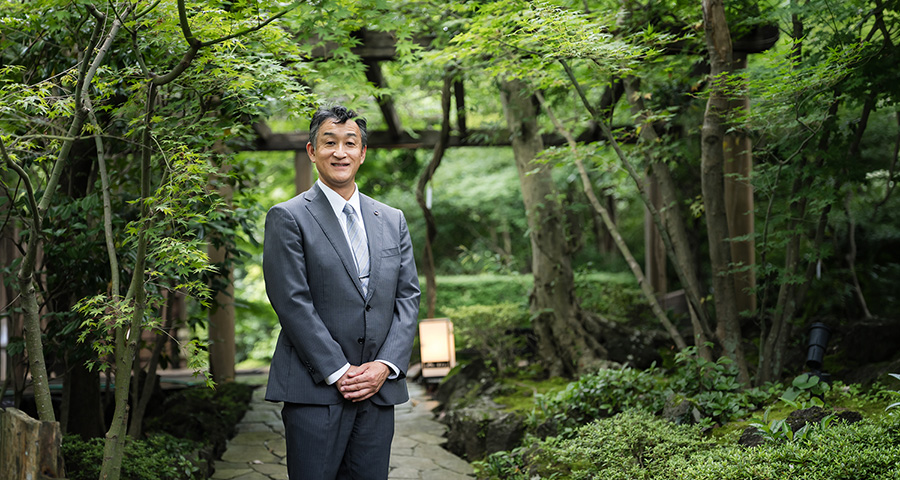
Set amid the unspoiled nature of Fuji-Hakone-Izu National Park, ABBA RESORTS IZU – Zagyosoh stands in a corner of Izu Kogen, an elegant villa enclave dotted with refined architecture. Spanning some 6,000 tsubo (approximately 20,000 square meters), this long-established ryokan has woven a history spanning more than half a century. As befits a property within a national park, the grounds are thick with trees and dazzling greenery. They rise almost like a small wooded hill, while clear streams and splashing waterfalls run through the expansive garden and colorful nishikigoi carp swim in the waters. Rain-soaked moss lends the landscape a quietly evocative charm.
A Hybrid Strategy Advanced by the New Owner
“We have just added six rooms—a combination of family maisonettes and villas—to the South Wing, which adjoins the main East Wing. Each guest room takes as its theme either a waka poem by Kakinomoto no Hitomaro from the Man’yōshū or a haiku by Yosa Buson, with the world of those poems woven into the interiors, colors, and other design elements. The new rooms began welcoming guests on July 7, 2026.”
The six newly built Japanese-modern guest rooms are all serene spaces that embody Japanese culture.
Ido joined Zagyosoh 28 years ago as deputy head chef. At the time, the ryokan was owned by its founder, the previous owner. Even then, it was renowned throughout the Izu Peninsula as a prestigious culinary ryokan, distinguished by its authentic kaiseki cuisine.
A major turning point came in 2012.
“The ryokan passed into the hands of its current overseas owner. Discussions about the transfer had begun around 2008. But in March 2011, a year before the transfer was completed, the Great East Japan Earthquake struck, leaving the future of the ryokan so uncertain that we did not even know whether it would survive.
“I thought the deal might simply disappear. Yet the current owner took over the business exactly as planned. His view was, ‘Ryokan are a culture found nowhere else in the world but Japan. We should make sure that this culture does not fade away, but continues into the future.’ I was Executive Chef at the time, and I was truly grateful. I felt nothing but appreciation.”
Naturally, there was some uncertainty as well.
“That said, because the owner was from overseas, I did wonder how a Japanese ryokan might change. But the very first thing he declared was his commitment to ‘passing on Japanese culture.’”
As for the buildings, some elements were preserved while others were renewed.
“Our operating policy has been a hybrid strategy: preserving the virtues of the traditional Japanese ryokan while responding to the needs of today’s guests. We have maintained the historic value of the main building with only minimal renovation, while also creating villas with private pools, pet-friendly rooms, and maisonette-style accommodations.”
The villa wing comprises 16 rooms scattered through the natural landscape a short distance from the main building, offering an exceptional degree of privacy. They call to mind the villas of Ubud in Bali. (Two additional newly built villas stand beside the main building.) Another feature guests particularly appreciate is that every room—not only the villas—has its own open-air hot-spring bath.
Three Distinctive Restaurants
If the property’s first great attraction is the magnificent natural setting that surrounds it, the second lies at the heart of its diverse dining. Under the new owner, the approach to dining changed considerably.
“We changed from the traditional style of serving meals in guest rooms to dining in restaurants. We continued our kaiseki cuisine, while introducing contemporary French cuisine and teppanyaki. As a result, we have seen more affluent guests, seasoned travelers, and guests staying for several nights.”
Izu: A Treasure Trove of Ingredients
Izu is also blessed with an abundance of fine ingredients.
“Our Japanese cuisine continues a tradition of kaiseki that has been carried on for more than 50 years. I also serve as Executive Chef, so I create the menus myself. These days I am extremely busy overseeing the ryokan as a whole, but I still step into the kitchen from time to time—I would not want my skills to grow rusty. Above all, what we are fortunate to have is the abundance of ingredients available in Izu. There is enough here for us to make local production for local consumption the basis of our cuisine.
First, there is the fresh seafood sourced from the Ito Fish Market and elsewhere in Shizuoka Prefecture—particularly kinmedai, kuromutsu (blackthroat seaperch), Ise-ebi (Japanese spiny lobster), kasago (scorpionfish), akahata (red-spotted grouper), and aori-ika. Ito Fish Market is only about a 30-minute drive away, so the fish that arrives from there is exceptionally fresh. In winter, we also offer a plan featuring wild tora-fugu (tiger pufferfish) from Lake Hamana. In fact, Lake Hamana ranks among Japan’s leading areas for landings of wild tora-fugu.
Then there are the vegetables, sourced in partnership with local farmers. We carefully select produce from nearby growers and, a little farther afield, from the renowned Mishima vegetable-growing area: miniature daikon, carrots, radishes, potatoes, onions, tomatoes, arugula, log-grown shiitake mushrooms, and more.
As it happens, my home is in the nearby mountains, so two or three times a week I buy vegetables directly from neighboring farmers and bring them to the ryokan myself on my way to work.”
And What About the Beef Served at Dinner?
Beef also appears on the evening kaiseki menu. How is the meat selected and prepared?
“We used to serve beef from Shizuoka, but because the supply was not always stable, we eventually settled on Japanese Black beef from Miyazaki. Japanese-cuisine chefs are not traditionally taught how to cook meat, so here we actively study techniques such as low-temperature cooking and continue to explore how best to prepare beef and duck.
We also use local Amagi Shamo chicken in our French cuisine. It has a wonderfully springy texture and is an excellent ingredient. Venison is delicious as well, so we are focusing on making greater use of it.”
The three restaurants—Japanese, French, and teppanyaki—are highly regarded for the quality of their cuisine. In 2017, the ryokan received awards in both the Japanese and Western cuisine categories of the internationally recognized World Boutique Hotel Awards.
“At the time, the French chef and I traveled to London for the awards ceremony.
The Japanese menu changes every two months, while the French menu changes with the seasons. Even if a guest staying three consecutive nights chooses only Japanese, French, or teppanyaki, we can vary the menu each evening. Naturally, we also accommodate vegetarian and vegan guests.”
It is unusual to find a ryokan so deeply devoted to gastronomy in the heart of Izu. Its ties with the surrounding community are equally strong.
“‘Prospering together with the local community’ is both the owner’s philosophy and our operating principle, so we source most of our ingredients from local producers and markets. In other words, we aim to grow in harmony with the regional economy.”
An Outstanding Approach to Culinary Training
“Traditionally, in professional kitchens, the accepted way for a master to train younger chefs was to tell them, ‘Watch and learn.’ Extreme strictness was taken for granted, and severe reprimands—and at times even physical punishment—were not uncommon. I came to Zagyosoh as deputy head chef. The head chef at the time was a renowned figure who served as chairman of the Shizuoka Prefecture chefs’ association. His thinking was completely different from the prevailing custom. He often told us, ‘We must not train young chefs the way we ourselves were trained.’ At the heart of his philosophy was the belief that ‘young chefs are our treasure.’
Of course, there were times when he became angry, but he would tell us, ‘If you have to reprimand someone, do it in a way they can understand and accept.’ That was extremely unusual at the time. His spirit is still carried on today, and careful, considerate instruction has become part of this ryokan’s tradition. As a result, we have been able to maintain a stable team—and above all, our strength as an organization has grown.”
Zagyosoh is also strengthening its partnerships with culinary schools. Within the industry, it is said to have become an established view that, whether for culinary training or employment, “you cannot go wrong with Zagyosoh.”
Rate Kimono and Japanese Swards, and encounters with Japanese Culture
The third attraction of the ryokan is the opportunity to experience and engage with Japanese culture.
“As I mentioned earlier, the owner has a deep reverence for Japanese culture—so deep, in a sense, that it could be said to surpass that of many Japanese people themselves. He already had an extraordinary kimono collection, and was also an avid collector of Japanese swords, with a collection said to be of museum quality. The kimono is displayed seasonally just inside the entrance, while the swords are exhibited in a dedicated gallery that guests may visit at any time.”
A small selection from the kimono collection includes an exquisite hand-painted Kyō-yūzen hōmongi featuring hitta-zome and a kazura-obi motif; a fully handwoven fukuro-obi in Kyoto Nishijin-ori; and a hōmongi by Toku Yūsui, the internationally acclaimed master of Kaga Yūzen.
Among the swords are works by Living National Treasure swordsmith Akitsugu Amata that may be regarded as the culmination of his life’s work, including pieces that represent the crowning achievements of his final years. The collection comprises more than 30 swords in all, only some of which are on display.
Guests may also take part, on request, in cultural experiences such as tea and making traditional fragrance sachets.
“I believe one of the great qualities of this ryokan is that guests can encounter aspects of Japanese culture that even Japanese people are beginning to forget—Japanese swords and kimono, as well as the tea ceremony and kōdō, the art of incense.”
Today, approximately 60 percent of guests are Japanese and 40 percent are international visitors. Rates range from ¥80,000 to ¥200,000 per person.
“After several rounds of expansion and renovation, I feel that the physical side of the ryokan is approaching completion. Our highest priority now is developing our people, and through that, raising the quality of our service to an even higher level. To achieve this, it is essential that all of our staff share the same sense of purpose, continue learning, and always strive for higher standards.”
Shinji Ido: Deputy General Manager of Zagyosoh
Born in Ito, Shizuoka Prefecture. In his early twenties, he trained at Wadakura in the Tokyo Palace Hotel and at other establishments. He joined Zagyosoh in 1999 as Deputy Head Chef and became Head Chef in 2007. In 2014, during the property’s renewal period, he was appointed Executive Chef. Since 2025, he has concurrently served as Deputy General Manager.
Zagyosoh
Address: 1741-42 Yawatano, Ito, Shizuoka 413-0232Phone: +81 0557-53-1170
Check‑in: 15:00 / Check‑out: 11:00