
The ryokan is a 30-minute drive from Echigo-Yuzawa Station on the Joetsu Shinkansen line, and a four-minute drive from Muikamachi Station on the Joetsu Line. Board the Shinkansen at Tokyo Station and you arrive in just two hours. Standing out in the city of Minamiuonuma, Niigata Prefecture, Ryokan Hotel ryugon is housed in a relocated traditional Edo-period wooden house.
A spacious, cozy lounge
The striking contrast between the wood and white walls of the exterior is captivating. The lounge, which stretches from reception to the back and beyond, encompasses several rooms, and is something that visitors invariably remark on.
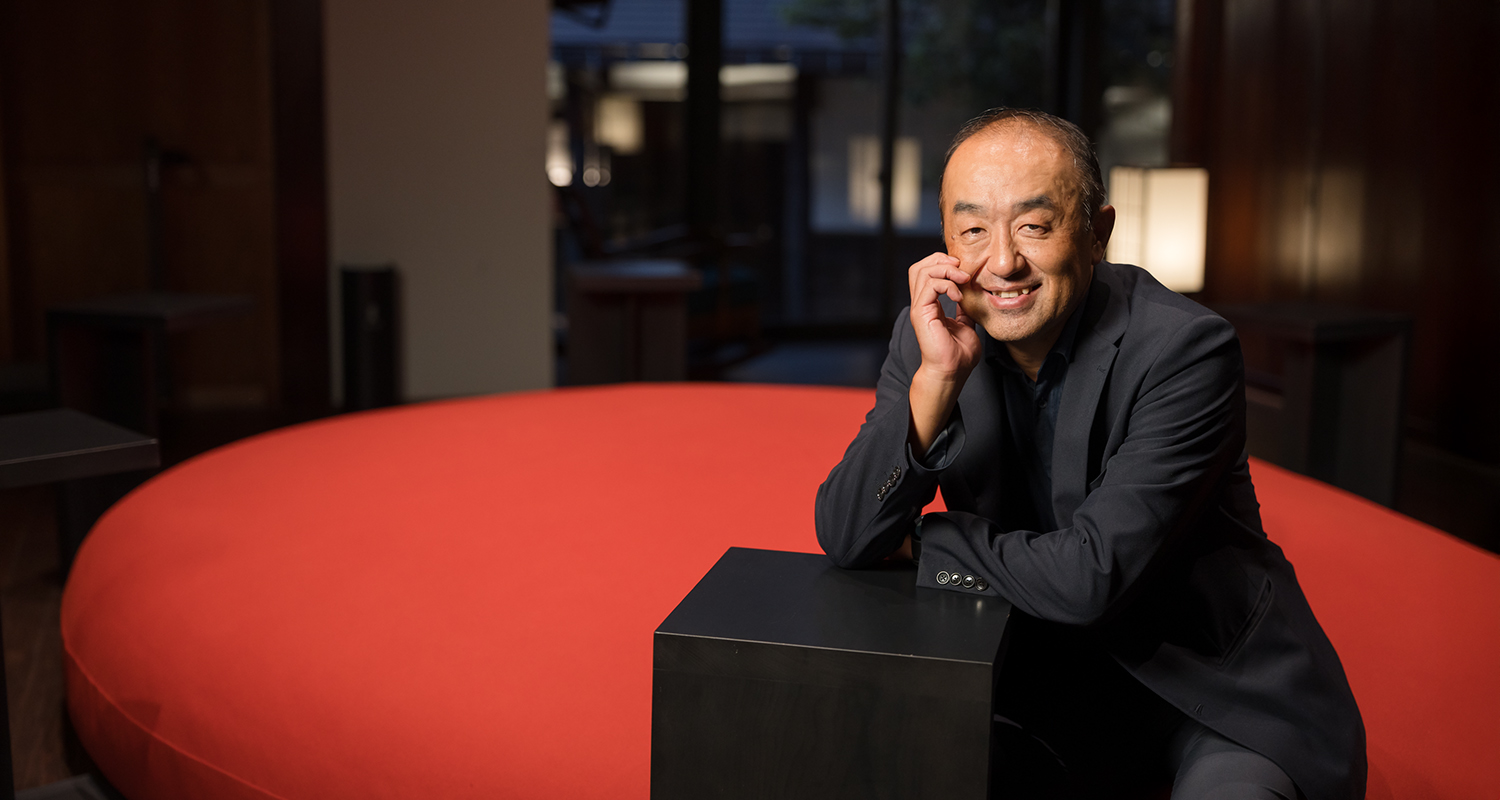
“You won’t find a lounge like this anywhere in Japan, so I thought it would be valuable, and that’s why I created it. My main goal was to create a place where international guests could relax,” says Mr. Tomohiro Iguchi, president of ryugon.
“When I see seasoned travelers, both foreign and Japanese, reading books here, I feel delighted that my goal has been achieved.”
In the area around the irori hearth is a bar counter and a library stocked with tasteful books. There’s also a wide variety of chairs, from artistic items to traditional floor chairs, tables, and sofas, including a snow hut-shaped sofa perfect for couples.
And yet, the space does not feel cluttered. As the view from the window changes, so does the mood. It is striking how many guests actually spend time relaxing in the lounge after dinner. Perhaps they prefer to linger there rather than return to their rooms.
Bottom-up approach for the entire community
Mr. Iguchi shares his thoughts on the relationship between the town and the ryokan.
“Muikamachi, Minamiuonuma City, where ryugon is located, isn’t a tourist town. A stroll outside the ryokan reveals people working in the beautiful rice fields. It’s a place where you can really get a feel for everyday rural life. The ryokan is close to the town center, so you can enjoy things like eating at a local izakaya pub. And because the ryokan is located at the foot of Mount Sakado, you can fully experience nature. This is the perfect location to enjoy both town and nature.”
Indeed, the greenery of the mountain’s looms close at hand throughout the ryokan, from the guest rooms to the lounge.
“What I want is for guests to stay multiple nights. One night isn’t enough to really understand the local culture. I want guests to enjoy the local culture and lifestyle while staying at this ryokan. It’s only by interacting with the locals that they can truly appreciate the importance of the culture. If they stay multiple nights, they can have dinner in town, then come back to the ryokan and have a drink over a light snack (the bar is open until midnight). Or maybe they’d like a light meal of soba noodles, curry rice, or a sandwich. That’s what our ryokan food menu is for. Of course, you can also order room service. That’s the kind of experience I want guests to have. The ryokan is merely a base for enjoying the town as a whole.”
Incidentally, there are also plans to allow guests to use the lounge and baths even if they’re not staying overnight. Every service imaginable is provided.
The idea behind the three conditions for repeat stays continues to grow.
“My philosophy is that if there are good local restaurants, the occupancy rate of the ryokan will increase. We work hard on the cooking at my own ryokan, but it’s even more fun when there are more good local restaurants. It makes you want to use the ryokan as a base and stay two or three nights. I travel all over the world, and when I find a place I want to go, there’s almost always a ‘surefire formula’. First, there’s a ryokan that makes you want to stay; second, there are activities that you want to experience; and third, there’s a good food culture. These three elements work together to create appeal. If even one of these conditions is missing, people probably won’t come back.”
That’s why ryugon offers such a wide variety of activities. There’s an incredible number of options. Wild vegetable and mushroom hunting, cycling through the rice paddies, trekking on Mt. Sakado, strolling around the town, and in winter, there’s snow shoveling, snow gastronomy, and snow picnicking in the snowy fields. Within the facility, there’s earthen-floor cooking, rice cracker baking, and delicious rice ball making in a clay pot … the list goes on. The 10 electric assist bicycles on offer are BESV, made in Taiwan, with a range of 90km. Visitors can go anywhere. There is also a program where you can rent a light truck and drive it through the mountains and fields.
“It’s the same idea as when we go to America and want to rent a pickup truck and drive through the desert or wanting to ride in a convertible when you’re in Hawaii. Wouldn’t it be Instagram-worthy if a woman in her twenties, wearing a straw hat, drove a little farm truck along a narrow road between rice fields?”.
A Ryokan is a collection of ideas
Mr. Iguchi’s journey to this point has been a long history of accumulated thought.
The original inn, Onsen Ryokan Ryugon, was built in the 1960s. The buildings were relocated from wealthy farmers’ mansions and samurai residences in the local Muikamachi area, built during the late Edo period. It is a complex of 16 houses, large and small, and the main building is designated as an Important Cultural Property. When management was transferred to Mr. Iguchi in 2019, it was renovated and took on its current appearance.
“I’ve been working on the Snow Country Tourism Zone since 2008, 17 years ago. The challenge was how to make the unique Snow Country culture take root in the region. That’s why when we renovated ‘ryugon’, our main focus was on expressing the local culture and lifestyle within the ryokan. We wanted to create a ryokan where guests could stay for an extended period while experiencing Japanese culture and enjoying a high-quality stay. To achieve this, we needed more than just an old building, so we also incorporated modern comforts. We aimed to create a ryokan where sophisticated travelers, like those who would stay for a week at a winery chateau in Burgundy, France, would feel comfortable. A ryokan is an accumulation of individual ideas, after all.”
Breaking down barriers and integrating into the community
“It doesn’t really feel like we’ve built a luxury ryokan on this land. First of all, ryokan have grand gates that give the impression of a ‘barrier’, as if only guests can enter. So, first we demolished that grand gate and changed the name from ‘Ryugon (龍言)’ to ‘ryugon’. By so doing, we wanted to get rid of the formality and make it blend in with the local area. So, this is not what you would call a ‘luxury ryokan’. It’s more a ‘ryokan hotel’.”
As soon as one passes through the gate, there is a cafe on the left, and on the right is a sizable select shop stocking local goods, to make it easier for people to step inside.
“Japanese people want a good ryokan that can be self-contained within the premises. But for people coming from overseas to experience local Japan, it doesn’t have to be an extremely luxurious ryokan. A four-star ryokan would be fine. They prioritize the travel experience.”
Still, the guest rooms are incredibly comfortable. Room rates range from just over 20,000 yen for a classic room to 200,000 yen for a newly built villa suite.
What is ‘Snow Country culture’?
So, what is this “Snow Country culture” that has been mentioned so far?
“When you think of Snow Country culture, it’s easy to think of old buildings, thatched roofs, and straw crafts. But that just leaves it as a legacy of the past. I believe culture exists within the context of past, present, and future. We have lived with snow, so I want to express the wisdom of life that has been nurtured here and look to the future. For example, the large red circular sofa and the round cushions around the hearth represent the heavy, round, humid snow of this region. The sofa next to the library is also inspired by a snow hut. All of these pieces of furniture are custom-made.”
What is the “Snow Country Tourism Zone” concept?
“It all started with the looming issue of the 2014 extension of the Shinkansen train line to Kanazawa. Until then, there was an express train from Echigo Yuzawa to Kanazawa, but once the Shinkansen was extended to Kanazawa, what would happen to towns along the way like ours? So, volunteers from seven towns and villages in Niigata, Gunma, and other areas got together to create the Snow Country Tourism Zone. The idea was to create a brand for the entire area that could rival Kanazawa. And at the heart of this is Snow Country culture. Other participants include President Iwasa of Satoyama Jujo, also from Niigata Prefecture, and President Kubo of Senjuan, from Minakami Village, Gunma Prefecture. Because we run a ryokan, we’ve been thinking for a long time about how to incorporate Snow Country culture into our facilities.”
The winter occupancy rate is nearly 100%
Therefore, winter seems to be the best time to appreciate it.
“The first floor is completely buried, and snow piles up to the second floor. It’s great to just sit there and gaze at the snow with a glass of red wine in hand. The snow itself has value. Our occupancy rate is almost 100% in winter, so our guests appreciate the winter. It’s just so cozy, I guess.”
“When they think of Niigata, people only think of ‘rice’ and ‘sake’. They think Nagano Prefecture is a better place for skiing. There are no World Heritage Sites or famous historical sites. Minamiuonuma is just another town like any other in Japan. So, I want to offer a thoughtful, unpretentious trip rooted in local culture. While we don’t have a specialty dish — our winter cuisine is packed with Snow Country culture.”
The food is impressive. The incredibly delicious full course “Snow Country Gastronomy” meal is packed with local ingredients.
“Of course, we provide the level of food our guest’s desire. The menu changes five times a year, but for three nights, we can change the entire menu. We are also 100% vegan and vegetarian-friendly. We can even accommodate requests on the day. We are constantly developing our menu, so we can provide vegan meals for three nights without any problems.”
Mr. Iguchi said the thing he most wanted people to try is early spring wild vegetables.
“I want to spread the word about wild vegetables to the world,” he said.
What really made an impression on this writer was the behavior of the local women serving rice at the breakfast buffet. They casually asked questions like, “How would you like the rice?” “Can I add a little more?” and “How about miso soup?” of the guests, who didn’t understand a word of Japanese. I think this kind of interaction is absolutely wonderful.
Links to the fundamental values of the region
Mr. Iguchi’s ideas are quite unusual. Or rather, his way of thinking about the ryokan in relation to the town is completely novel.
“I was originally the fourth-generation owner of the Echigo Yuzawa HATAGO Isen ryokan, located in front of Echigo Yuzawa Station. After graduating from a local high school, I went to study at an American university, majoring in marketing at the School of Business at Eastern Washington University in Spokane, Washington.”
He thought he would go on to get an MBA but realized he had no work experience and returned home.
“At the time, my parents’ house was a hot spring inn in front of the station called Yuzawa View Hotel Isen. It costs about 10,000 yen a night. Management was difficult, so we had to turn it around and reopened it in 2005 as Echigo Yuzawa HATAGO Isen. As we were doing that, I began to think that we needed to rebrand the city of Yuzawa itself. Yuzawa has such a strong image of skiing and hot springs that it would be difficult outside of the ski season. So, 17 years ago, I set up the Snow Country Tourism Zone myself and have been working on it ever since. That led to the story of how we decided to renew ‘ryugon’.”
“If it were just a luxury ryokan, there would be plenty of competitors, and from the customer’s perspective, it wouldn’t matter if it wasn’t us. So, I wanted to compete in the blue ocean of Snow Country culture. If we were a single ryokan, we would quickly lose. But a region can’t be imitated, even if it wants to. If we create a ryokan that is tied to the absolute values of the region, it becomes very strong. If we tackled this battle alone, we wouldn’t be able to win, but we are doing it as a whole region, along with other ryokan and related restaurants. I believe that this is how Japan’s regions can thrive.”
Tomohiro Iguchi : The proprietor of ryugon
Born in Yuzawa, Minamiuonuma District, Niigata Prefecture in 1973. After graduating from Eastern Washington University’s School of Business, Department of Marketing, he took over the family ryokan business as the fourth-generation owner and renovated Echigo Yuzawa HATAGO Isen in 2005. In 2008, he served as a planner for the Snow Country Tourism Zone, which comprises seven surrounding cities and towns, and has worked hard to manage it. He also serves as a member of the Japan Tourism Agency’s Tourism Industry Review Council. In 2013, he founded the Snow Country Tourism Association and became its representative director. He is a core member of wide-area tourism projects, including tourism quality standards, human resource training, and CSR initiatives. His publications include “Yukimaroge Management Theory” (2013, Hakurosya).
ryugon
Address: 1-6 Sakado, Minami-Uonuma, Niigata 949-6611Phone: +81 025-772-3470
Check‑in: 15:00 / Check‑out: 12:00