
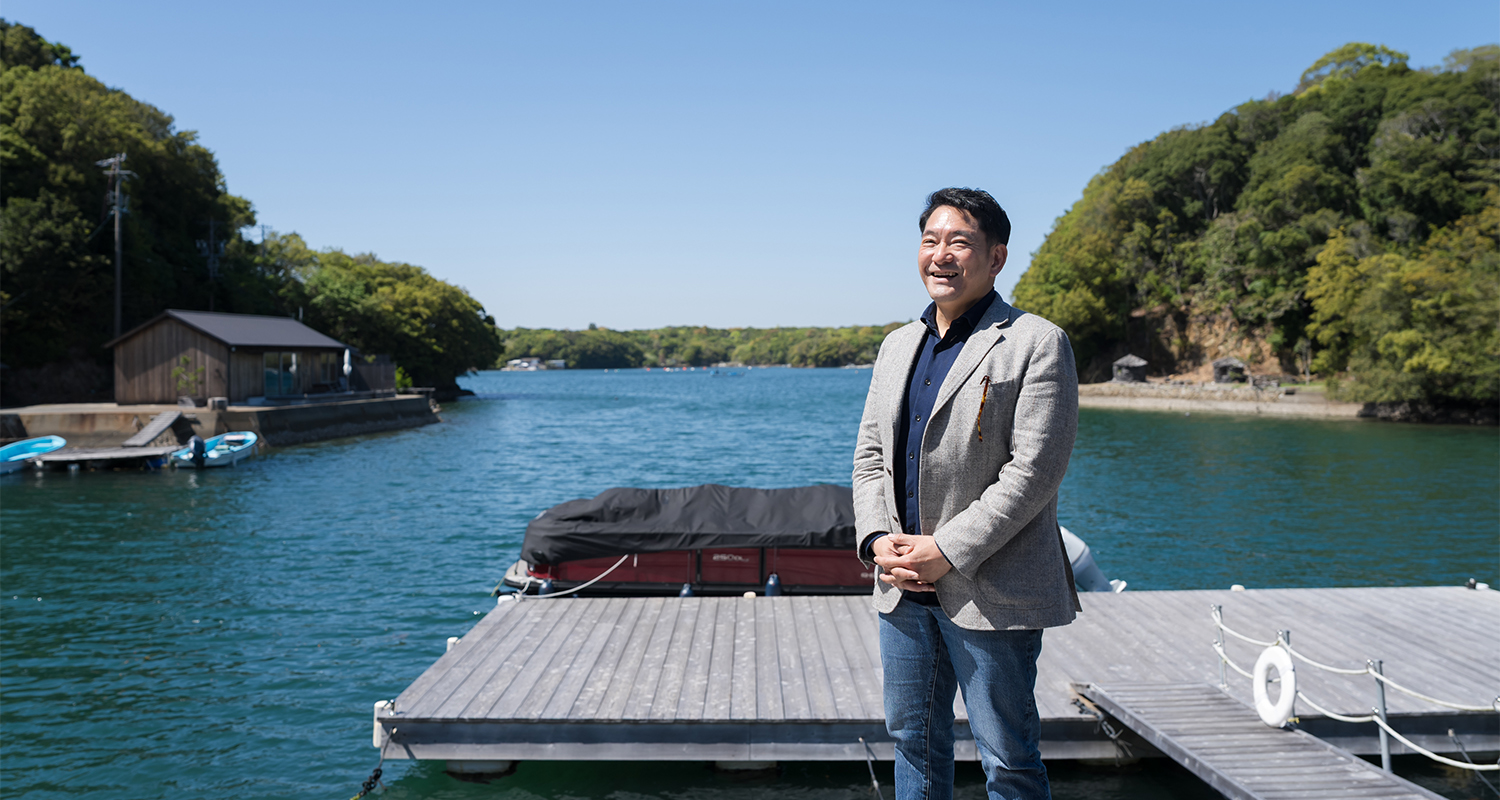
The COVA KAKUDA ryokan is situated on the shores of a quiet cove on Ago Bay, within Ise-Shima National Park in Mie Prefecture, about a 30-minute drive from Kintetsu Kashikojima Station. This June marks its third anniversary since opening. Within its vast 40,000 square meter grounds, there are fewer than 10 buildings.
A one-of-a-kind retreat where you become one with nature
The property comprises a reception pavilion, a restaurant, a dedicated sauna facility, and four private villas designed for guest accommodations. During the winter months, when strong northwesterly winds sweep across Ago Bay, waves crash against the restaurant’s expansive windows, bringing guests remarkably close to the sea. The villa nearest the shoreline sits so close to the water that, from its deck terrace, it feels as though you could reach out and touch the surface of the bay.
Beyond the restaurant building lies a tranquil cove, embraced by lush, forested hills on either side. From the comfort of the sofa, guests can gaze out across the water as small fishing boats drift quietly through the distance. In this serene setting, time seems to slow to a gentle pause.
Is there any other location that offers such a profound sense of oneness with nature and tranquility? This is the ultimate luxury—this is what true luxury really means. A hotel nestled between the sea and the surrounding mountains is truly one of a kind.
Few places offer such a profound sense of harmony with nature and such deep tranquillity. This is luxury in its purest form—not extravagance, but the rare privilege of immersing oneself in an extraordinary natural setting. Embraced by the sea before it and forested hills on either side, COVA KAKUDA is a destination unlike any other.
A superb location where the sea and mountains intersect
Mr. George J. Kakuda, owner and president of COVA KAKUDA, shares the vision and philosophy behind the property.
The story and Inspiration behind the name “COVA KAKUDA”
“Our family has been involved in pearl cultivation and pearl processing for three generations. Ago Bay is the birthplace of pearl farming in Japan, and the industry reached its peak during the 1950s and 1960s. Before the hotel was built, this site was dotted with facilities used for pearl cultivation and processing. At the time, these factories were known locally as ‘koba.’ The name ‘COVA’ is inspired by that heritage. ‘KAKUDA’ comes from Kakuda Pearl Co., Ltd., the family company that operates the ryokan.”
Kakuda Pearl is known as one of the longest-established companies in the pearl industry.
“At its peak, around 120 people worked at the facility. It continued operating as a pearl-processing plant until 1970, but as pearl prices collapsed due in part to overproduction, the number of pearl farmers in Mie Prefecture steadily declined. Eventually, the facility fell completely out of use. Even after that, however, the site remained a familiar part of my life. I would spend weekends there with my parents, and during my student years, it served as a venue for summer training camps with my sports club. My grandmother was also an ama, one of Japan’s traditional female free divers. When I was a child, we would gather turban shells and abalone together. From May through the summer months, sillago were plentiful in these waters, and my mother would often prepare them as tempura. Those experiences gave me an intimate understanding of the sea and a lasting affection for the waters of Ago Bay.”
“So whenever I imagined guests coming here, I found myself accumulating all kinds of ideas—activities they might enjoy, and ways we could make their stay truly memorable. I spent years letting my imagination run with those ideas, and that was about a decade ago. Then, around the time of the pandemic, the government introduced a business restructuring subsidy program. With support from that program, together with my own investment, those long-held visions gradually began to take shape.”
A sense of becoming one with nature
A decade ago, in 2016, Ise-Shima hosted the G7 Summit.
“At that time, we were commissioned to create pearl lapel pins for the world leaders attending the summit. We carefully selected the pearls through a competition, choosing only the very finest. As we worked on the project, I found myself asking what it was that we truly wanted to communicate through those lapel pins. It wasn’t simply the beauty of the pearls themselves. I came to realize that what mattered most was conveying the satoumi way of life that lies behind their creation.”
“In other words, satoumi is the idea that nature becomes richer and more abundant through people’s active involvement with it. But I also realized that this is something that cannot be fully understood on a day trip, even if people travel here from the city. To truly appreciate it, they need to spend time here. That made me keenly aware of the importance of having accommodation.”
Originally a factory, the building still retains its original framework and structural beams.
“We renovated it while minimizing the impact on nature as much as possible,” says Mr. Kakuda.
The renovated interiors are warm and inviting, with the natural hues of Owase cypress and white walls creating a sense of understated elegance. Thoughtfully chosen furnishings and carefully curated details enhance the atmosphere throughout. Whether in the guest villa or the dining room, guests gradually find themselves immersed in the spirit of the place, experiencing an almost seamless connection with the surrounding natural environment.
How can a ryokan contribute to the local community?
Yet Mr. Kakuda’s vision extends far beyond the interests of his own company.
“I live in Ise City, about a 50-minute drive from here, but every time I visit Oku-Shima, at the far end of the peninsula, I am reminded of the challenges facing the region as its population continues to decline and communities grow smaller. I felt that if we could create jobs that would attract people from outside the area, it might help slow that trend, even if only to a small degree. I also began thinking about how a tourism business could support the local economy—not only the pearl-farming industry, but also the fishermen who make their living harvesting seaweed and catching fish. The more I considered it, the more I realized that operating a hotel here could create value in many different ways. That is why, despite the challenges, I decided to take on the project that became COVA KAKUDA.”
Yet there is a larger issue at stake.
Satoyama—the traditional Japanese landscape where people and nature coexist in harmony—is a concept that has become widely known. In Ise-Shima, however, there is also satoumi: a coastal environment nurtured through the long-standing relationship between people and the sea. It is this satoumi that has sustained the region’s abundance, including its pearl industry. Today, however, that environment faces serious challenges.
“The rias coastline was formed by the uplift of the seabed, creating flat terraces along what were once mountain ridges. In the past, these terraces were cultivated as farmland. Farmers enriched the soil with compost and other organic matter, and when it rained, those nutrients were carried into the sea. The result was a rich and productive marine environment. Seaweed flourished, fish were abundant, and shellfish such as hiougi scallops and oysters thrived. The nutrient-rich waters also provided ideal conditions for akoya pearl oysters, which are used in pearl cultivation.”
“Fishermen involved in seaweed cultivation, pearl farming, and shellfish aquaculture would collect the organic matter removed from shells and equipment during cleaning, along with the inedible portions of their harvests, and mix it with fallen leaves before returning it to the soil. This created a large, interconnected cycle that once sustained the region of Ise-Shima. However, as depopulation progressed and fewer people remained to work the land, that cycle began to break down. The sea quickly lost much of its richness. Seaweed beds declined, fish populations dwindled, and shellfish no longer thrived as they once had.”
So, what can be done?
“We have to restore the richness of the sea. In a sense, it is a process of regenerating the marine environment. COVA KAKUDA is located on a small inlet, where the condition of the sea is closely influenced by the surrounding land. If that is the case, then we should begin by caring for the land. By properly managing the forests—allowing more sunlight to filter through the trees and improving air circulation—we can encourage the formation of rich humus. Organic waste generated through fishing can be composted and returned to the soil. If agriculture once again becomes part of the landscape, nutrients will naturally flow back into the sea.”
“Setting aside the challenge of rising sea temperatures, I don’t believe it would be impossible to restore these waters to something close to what they were in the 1950s. COVA KAKUDA stands at the point where satoyama and satoumi intersect. In other words, by living and working in harmony with nature here, we can help restore the natural cycle. That is the fundamental philosophy that underpins COVA KAKUDA.”
What Mr. Kakuda has envisioned is far more than the creation of a hotel. It is an extraordinarily ambitious attempt to restore both satoumi and satoyama through hospitality—a concept that has few, if any, precedents in Japan.
A variety of activities
First, there’s the satoyama lifestyle.
On the mountain side, they’ve created a farm with vegetable patches, an olive grove, an herb garden, and a shiitake mushroom farm. They also raise two breeds of chickens: Silkies and Araucanas, which lay blue eggs. They’ve even started beekeeping.
“Along the coast, there are groves of ubame-gashi oak, the tree used to produce Binchotan charcoal. While Kishu is best known as the home of Binchotan, these trees are also abundant in Ise-Shima. We work with local charcoal makers who selectively harvest the trees. The larger sections of wood that are not suitable for charcoal are left to dry naturally for about two years, after which they make exceptional firewood. Today, that wood is used in our fireplaces and saunas. When it burns, it releases a distinctive fragrance that reflects the character of the local forest.”
“We’ve also built a pier specifically for guests to cool off after the sauna. Many enjoy relaxing there as part of the sauna experience, and plenty of our Japanese guests take a plunge into the bay as well. We use locally produced Ise-Shima Binchotan charcoal in our cooking, so in a sense, we’re grilling local ingredients with wood from the local forests. It’s another expression of the close relationship between the land and the sea.”
It is a rare place where the bounty of both the mountains and the sea can be enjoyed to the fullest. The question, then, is what kinds of experiences the satoumi way of life can offer.
“In simple terms, we want guests to experience a sea that exists in close relationship with people. We want them to gain a firsthand understanding of the livelihoods of those who make their living from it. For example, during the winter months, we might take guests to a hiougi scallop farm, bringing along a traditional charcoal grill so they can cook and enjoy the scallops right where they are raised. We also offer opportunities to join local fishermen and experience removing spiny lobsters from the gill nets in which they have been caught.”
“There is a young man who used to build cars at Toyota but was so drawn to this sea that he decided to train as a pearl farmer. From around May, the process of inserting nuclei into akoya oysters begins, and guests can even take part in that experience.“
“Our most popular activity, however, is a visit to the fish market at a nearby fishing port. Fishing boats usually return shortly after seven in the morning, allowing guests to watch the catch being unloaded and auctioned. Although the daily catch is limited to 300 kilograms, tuna is often among the fish landed there. We sometimes serve fish, shellfish, and spiny lobster selected that very morning as part of the evening’s dinner. What we want guests to experience is how the people who make their living from the sea live and work alongside it. That, to me, is what makes this place so special—although I should warn you, the local dialect isn’t always easy to understand. From my own travels, I’ve come to believe that the most rewarding travel experiences come from encountering something that can only be found in that particular place.”
There is also an incredibly diverse range of other activities.
Satoyama nature walks; firewood splitting & traditional fire-making; natural plant dyeing & essential oil distillation; matcha in a hillside pavilion; rias coast kayaking & kayak fishing; Island snorkeling; surfing; fishing (including offshore charter trips); sunset cruises; night cruises; bonfires & stargazing; beekeeping experiences…
Why offer so many activities?
“There is certainly a kind of revitalization that comes from arriving at a ryokan, doing absolutely nothing, completely unwinding, and returning home feeling refreshed. I think that’s one wonderful way to travel. Personally, though, I see people as being a bit like pendulums. We experience the deepest sense of relaxation after first challenging ourselves, then letting go. That’s why I believe that enjoying activities and experiencing a moderate amount of stimulation can actually lead to a more profound sense of relaxation. With that in mind, both my staff and I are constantly creating new experiences for our guests. I host the matcha experience myself, while each member of the team contributes activities that reflect their own interests and expertise.”
Regenerative beyond sustainability
Mr. Kakuda has a grand vision for the future.
“What’s more, people are not separate from nature. When we engage with it thoughtfully, nature itself can become richer. That is part of a much larger cycle, what you might also call a circular economy. If our guests can sense that cycle, I think they’ll leave with a genuine sense of peace. And after a day filled with meaningful experiences, the quiet moments that follow become all the more fulfilling. That’s when a deep sense of relaxation naturally settles in.”
In short, what is being practiced here represents the next stage of sustainability. Simply being sustainable is no longer enough for the sea and the mountains. What they need now is regeneration.
“With sustainability, if even one part of the cycle is lost, the whole system eventually stops working. What we are aiming for is something different—a cycle that continues, grows stronger over time, and becomes increasingly beneficial. That is what regenerative thinking is about: not simply sustaining what already exists, but continually restoring, enriching, and improving it. That is the philosophy we strive to put into practice at COVA KAKUDA.”
That is why there is nothing ostentatious about COVA KAKUDA. Instead, it offers a truly luxurious retreat where guests can experience nature with all their senses. Perhaps that is why it continues to attract a growing number of discerning repeat guests from both Japan and abroad.
COVA KAKUDA’s commitment to nature can also be seen from another perspective.
“There is waste generated during the pearl farming process. For example, styrofoam and rope. This waste accumulates in large quantities when businesses close down and are unable to dispose of it themselves. Since it’s waste generated as part of the industry, we take responsibility for cleaning it up as part of our industry’s responsibility. There is a nationwide organization called the Japan Pearl Exporters Association, and I am its chairman. I am constantly thinking about how to promote Japanese pearls. From that perspective, I believe these cleaning activities are just as important as promoting the beauty of pearls to the world.”
The ultimate goal is the revitalization of the entire area.
The dining experience also deserves special mention.
“Chef Matsumoto used to be a sous chef at a traditional Japanese ryokan. At first, I wasn’t particularly excited by his kaiseki (traditional Japanese haute cuisine), so I took him to various restaurants I liked. What I told him was, ‘Cross borders.’ ‘Let’s cross borders with the heart of Japan. Let’s freely use various cooking methods and ingredients. What I admire most about Chef Matsumoto is that while he has a clear vision of his own, he is always willing to listen to others. His cuisine has now reached the point where I simply have nothing left to add”.
The cuisine could best be described as innovative fusion rooted in Japanese culinary traditions. While the menu changes with the seasons, it consistently showcases the finest ingredients from Ise-Shima, including spiny lobster, akoya oysters, aonori seaweed, blue crab, striped jack, and renowned Matsusaka beef. The dinner course comprises around eleven dishes. Centered on the bounty of Ise-Shima, it draws on Japanese, Western, and Chinese culinary techniques while always remaining true to a single principle: bringing out the very best in each ingredient. Every dish is thoughtfully composed, resulting in an exceptional dining experience from beginning to end.
Finally, Mr. Kakuda is looking beyond the success of COVA KAKUDA itself to what it can bring to the wider region.
“If what we’re doing at COVA helps restore the richness of both satoumi and satoyama, and people begin to see that this approach creates a healthier environment, I believe it has every chance of spreading to other parts of Ise-Shima. When you cruise around the bay, you quickly notice the many abandoned pearl-farming and aquaculture huts. If COVA proves successful, I hope more people will be inspired to renovate those buildings and give them a new purpose. Imagine small accommodations—some accessible only by boat—emerging one after another around the bay. If that kind of organic growth takes place, people will begin to say, ‘There’s something special happening in this part of Ise-Shima.’ That’s what I hope to see.”
George J. Kakuda: Owner and President of COVA KAKUDA
Graduated from the Department of Social Sciences, College of Liberal Arts, International Christian University in 1995. He joined Mikimoto Co., Ltd. the same year. In 1997, he joined Kakuda Pearl Co., Ltd., and became president in 2014. He also served as chairman of the Japan Pearl Promotion Association's Pearl Certification Committee, establishing the pearl certification system. He was a member of the Japan Pearl Promotion Association's Research Committee, participating in the development of the Pearl Standard. As vice-chairman of the Japan Pearl Exporters Association, he was involved in the development of the Japan Pearl Pavilion Rule. As chairman of the Mie Prefecture Pearl Promotion Council, he led the lapel pin project at the 2016 Ise-Shima G7 Summit.
COVA KAKUDA
Address: 1397-14 Katada, Shimacho, Shima-city, Mie Prefecture 517-0701Phone: +81 0599-52-0231
Check‑in: 14:00 / Check‑out: 11:00